

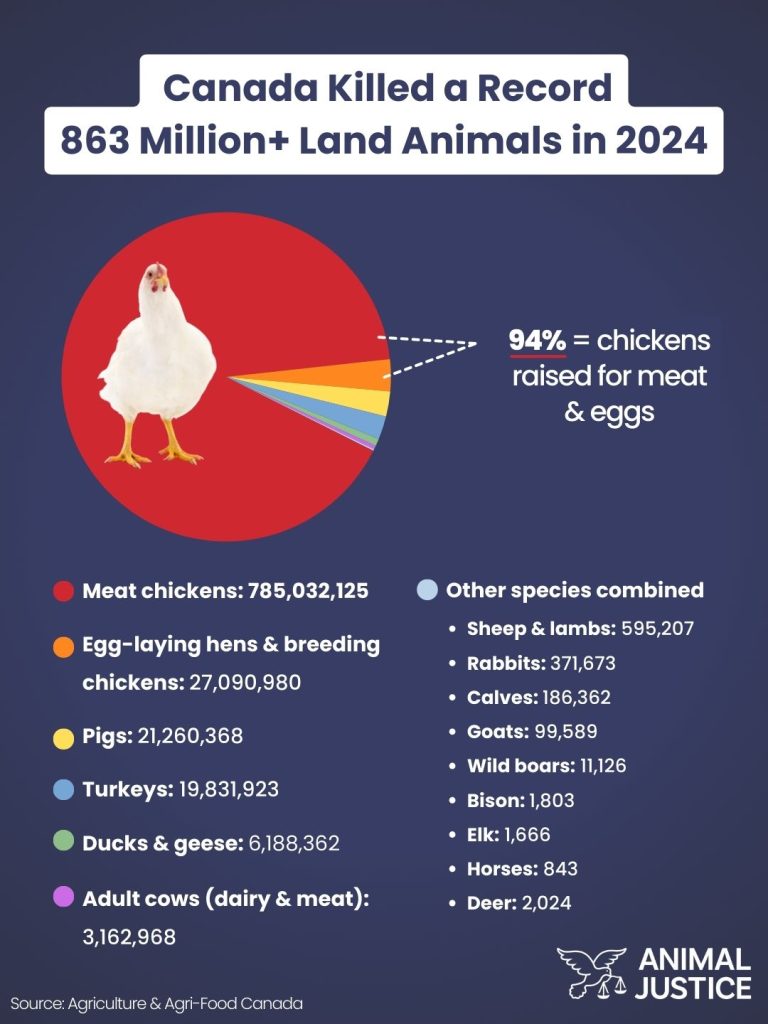
Canada slaughtered a record high number of animals for food in 2024. Government slaughter statistics analyzed by Animal Justice reveal that a staggering 863 million land animals were killed—each one a thinking, feeling individual who suffered in a food supply chain that treats sentient beings as mere commodities.
It is difficult to grasp the horror of 863 million deaths. This number is about 21 times larger than the entire human population of Canada. If each individual animal’s death took one second, it would take 27 years of non-stop counting to reach 863 million.
The overwhelming majority of animals killed for food spend their short lives packed tightly together in filthy warehouses, often in cages, within self-regulated factory farms. Most animals are still babies when they reach “kill weight” and are trucked to slaughter, killed at a fraction of their natural lifespan.
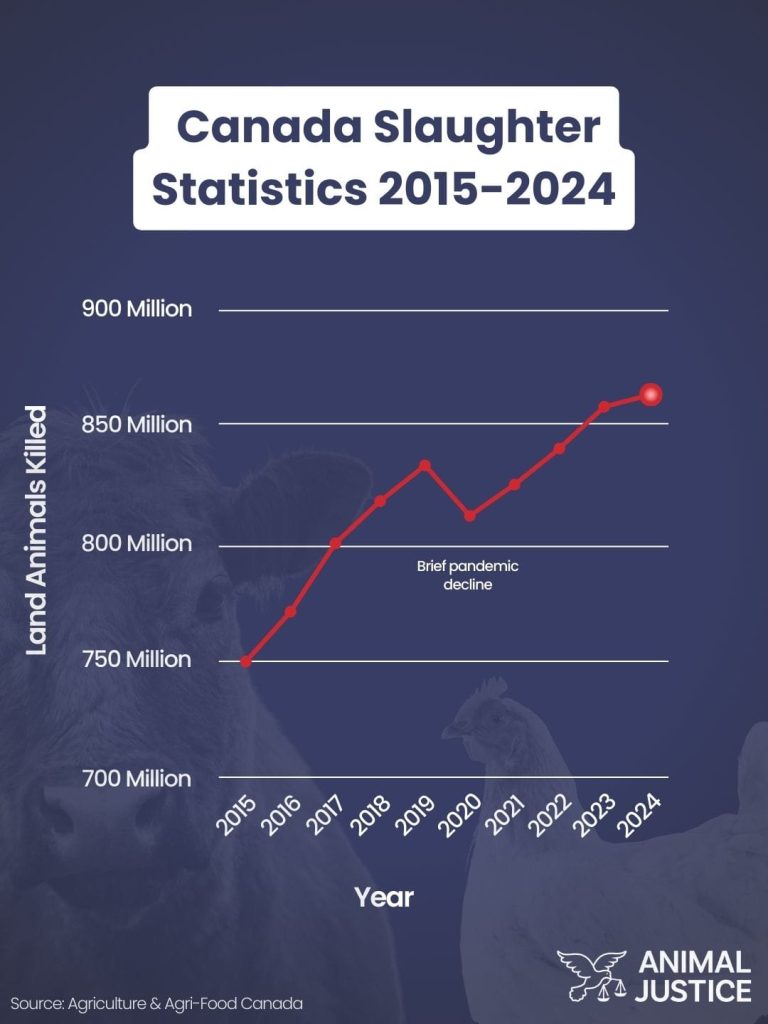
Increase in Number of Animals Killed From 2015-2024:
- 863 million in 2024
- 859 million in 2023
- 841 million in 2022
- 825 million in 2021
- 812 million in 2020
- 834 million in 2019
- 819 million in 2018
- 800 million in 2017
- 771 million in 2016
- 750 million in 2015
The number of animals killed for food dipped during the pandemic in 2020-21, but has otherwise climbed steadily.
More Animals Are Killed Every Year
In less than 10 years, the number of land animals killed for food in Canada has risen by over 100 million, from 750 million in 2015 to 863 million in 2024. Most of the increase is due to increased killing of chickens. Although demand for cow and pig meat has gone down, chicken production has tripled since the 1980s. This is due to factors including population growth, propaganda-based claims promoting chicken meat as a healthier or less polluting option, price competitiveness, and an increase in chicken meat use in fast-food restaurants.
Chickens are also physically smaller than cows or pigs, meaning that many more animals are killed to obtain the same amount of flesh.
Animals Killed Broken Down by Species
- Meat chickens: 785,032,125
- Egg-laying hens & breeding chickens: 27,090,980
- Pigs: 21,260,368
- Turkeys: 19,831,923
- Ducks & geese: 6,188,362
- Adult cows (dairy & meat): 3,162,968
- Sheep & lambs: 595,207
- Rabbits: 371,673
- Calves: 186,362
- Goats: 99,589
- Wild boars: 11,126
- Bison: 1,803
- Elk: 1,666
- Horses: 843
- Deer: 2,024
TOTAL: 863,837,019
The numbers above only count the animals who are slaughtered and enter the food supply, but many more deaths in farming go uncounted each year. This includes:
- Animals who die on farms due to illness or injury.
- Approximately 40 million newborn male chicken and turkey chicks killed in hatcheries annually, considered useless because they do not produce eggs.
- Almost 21 million cows, pigs, sheep, horses, chickens, and other birds exported live to other countries.
- Millions of animals killed or injured in transport who don’t enter the food system.
- In 2024, almost 3 million chickens and turkeys; 14 million ducks and geese; 11,000 pigs; and over 3 million cows culled due to infectious disease outbreaks like avian influenza.
- Billions of aquatic animals killed, including lobsters, fishes, crabs, and clams. Their deaths are reported separately only by weight, their individuality ignored. Animal Justice’s analysis of the most recent data estimates that over 8 billion aquatic animals are killed each year.
- Millions of farmed animals who die in barn fires each year.
- The government also refuses to release data on the number of horses who are slaughtered for meat, unfairly shielding the horse meat industry from scrutiny. The last year this data was available was 2016, which saw 54,000 horses slaughtered.

Lack of Legal Protection for Farmed Animals
Canada has no legislation dedicated to protecting animals on farms, and standard farming practices are considered exempt from general animal cruelty laws. Instead, the animal agriculture industry makes up its own voluntary standards through the National Farm Animal Care Council (NFACC), an industry-dominated organization with no independent enforcement or public verification mechanisms.
Although laws do apply during transport and slaughter, animals still routinely experience long, gruelling transport in freezing cold or extreme heat with little protection from the elements and without suitable food or rest. They are then brutally killed, often in sight of other animals, in industrial slaughterhouses that prioritize line speed over welfare. As a result, live animals are regularly scalded, skinned, or cut apart while conscious. The regulations that do exist are inadequate, and enforcement is weak, with violations typically resulting in easily-paid fines.
At Animal Justice, we believe animals need lawyers. Animals on farms deserve laws and inspections to ensure those laws are being followed. Our legal team has made it their mission to overhaul the legal system to protect animals from the widespread cruelty and neglect that they endure. Please join our compassionate community and help make real, lasting change in the lives of animals.
Banner: Gabriela Penela | We Animals