

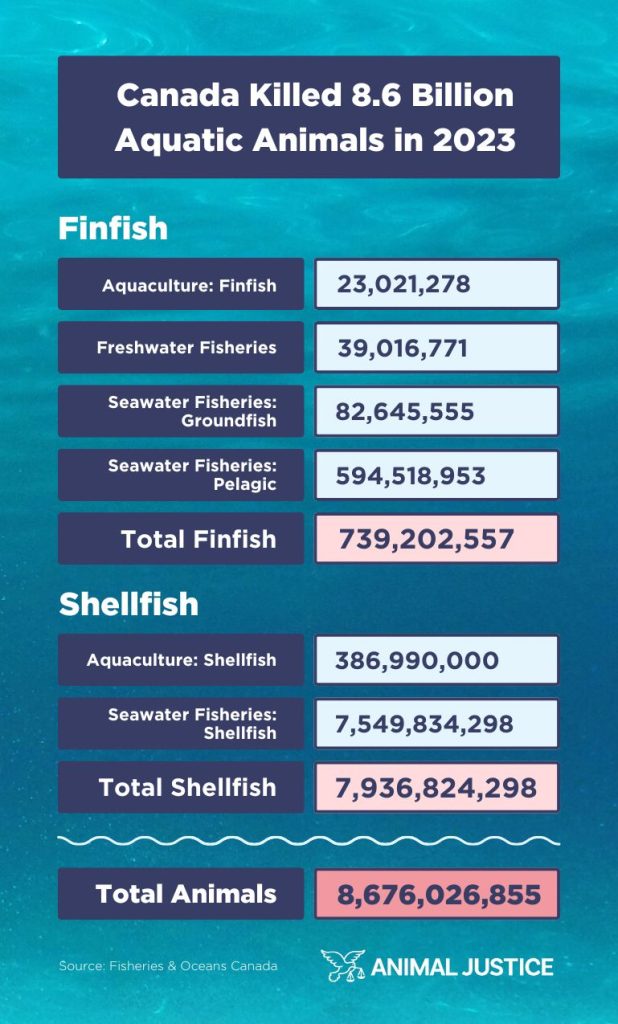
An estimated 8.6 billion aquatic animals were killed for food in Canada in 2023, according to a new analysis from Animal Justice based on government statistics. This represents about 1.5 billion fewer deaths than 2022, largely due to a decline in fish farming. National aquaculture sales fell by 4.7 percent, with farmed finfish production dropping nearly 16 percent overall. This was primarily driven by a 41 percent decline in British Columbia’s farmed finfish production, likely linked to the government-mandated phase-out of open-net salmon farms. Farmed shellfish production also fell by 4.5 percent.
While fewer individuals were farmed and killed in 2023 compared to 2022, the quantity of victims remains staggering. Aquatic animals are by far the largest group of sentient beings killed for food in Canada—over ten times the number of land animals in the same year.
Fishes and other aquatic animals such as shrimps, crabs, and lobsters are intelligent and emotionally complex beings. Research shows they experience a wide range of emotions, from fear and stress to curiosity and joy. Many species recognize individuals, remember past experiences, form social bonds, and cooperate to solve problems.
Yet despite overwhelming evidence of their sentience, Canada’s laws treat aquatic animals as if they were incapable of suffering. Their nervous systems and pain receptors function much like our own, but virtually no legal protections exist to shield them from the immense suffering caused by commercial fishing and intensive fish farming.
How We Got the Numbers
Government statistics only measure aquatic animals’ lives in tonnes, not as individuals. To reveal the true scale of suffering, Animal Justice divided the total landing weight of each species by the average weight of an individual. This gave us a rough estimate of how many individual animals are killed in Canada’s fishing and aquaculture industries each year.*
Beneath the Surface: Mass Suffering Caused by the Fishing Industry
In 2023, roughly 95 percent of aquatic animals killed for food in Canada were wild-caught, while about five percent were farmed.
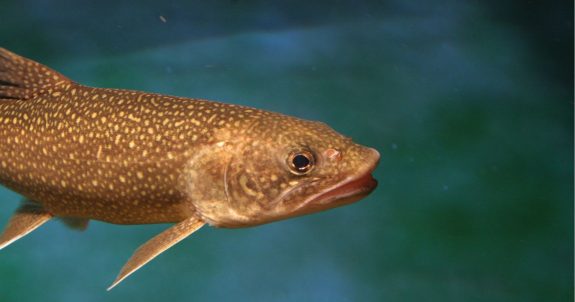
Nearly 7.9 billion shrimps, lobsters, crabs, scallops, and other shellfishes were killed for food—making up the majority of aquatic victims. Shrimps alone represented almost 6 billion individuals. Meanwhile, an estimated 739 million finfishes were killed for food, including wild-caught species such as herring, capelin, and cod, as well as farmed salmon and trout raised in crowded aquaculture cages.
Commercial Fishing in Canada
Canada’s commercial fishing industry uses massive contraptions designed for maximum efficiency, but each method causes immense suffering and widespread environmental harm. Some estimates suggest that bycatch—whales, dolphins, turtles, seabirds, and non-target fishes who get caught in fishing gear—could nearly double the number of animals killed by the fishing industry each year. Animal Justice’s estimates do not include these individuals.
- Trawl nets are dragged along the ocean floor or through open water. This practice results in the crushing and suffocation of countless fishes and other aquatic animals, often catching many non-target species. These nets also rip up delicate ecosystems like coral reefs and seagrass beds, which disrupts food chains and significantly impacts biodiversity.
- Gillnets are large walls of mesh that entangle animals by their fins or gills, trapping not only target species but also seals, dolphins, and seabirds who drown after becoming ensnared.
- Longlines stretch for kilometers with thousands of baited hooks, hooking fishes through their faces or bodies, causing immense pain and distress, leaving them to sometimes struggle for hours before dying from exhaustion. It is estimated that at least 160,000 seabirds are killed each year in longline fisheries, as well as thousands of other non-target species.
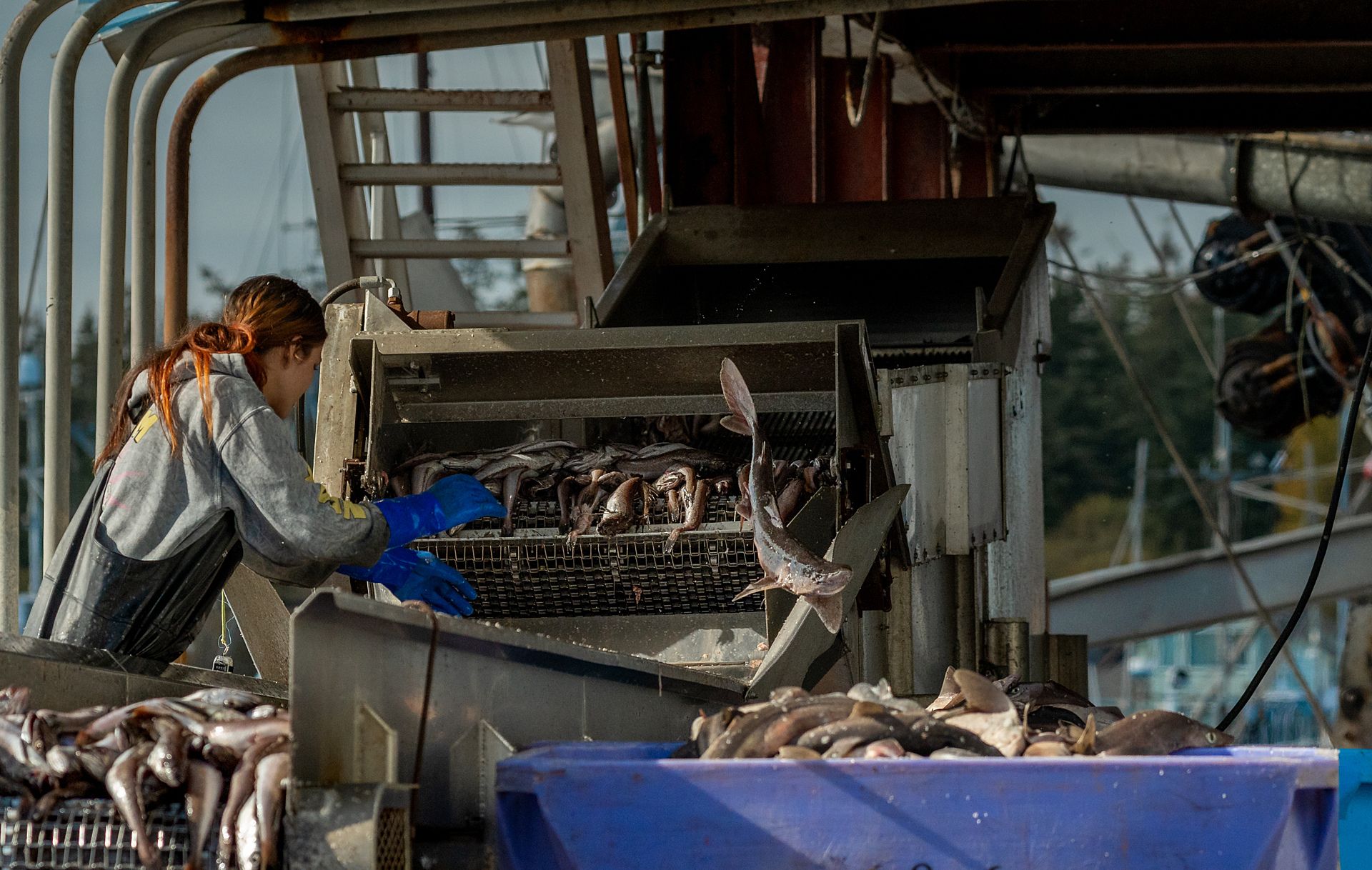
Photo: Suzanne Goodwin | We Animals
Fish Farming in Canada
Fish farming, also known as aquaculture, is often promoted as a ‘sustainable’ alternative to commercial fishing, but it’s far from humane and produces immense pollution.
Inside fish farms, fishes are confined in overcrowded net pens or tanks, where they endure chronic stress, disease outbreaks, and aggression. Many die long before slaughter from infections, starvation, or injuries.
The devastation extends beyond the farms themselves. Fish farms also pollute surrounding ecosystems, releasing a toxic mix of waste, uneaten feed, antibiotics, and chemicals into waterways. This contamination harms wild marine life, disrupts fragile ecosystems, and spreads disease to wild populations.
Animal Justice investigations in recent years have revealed shocking cruelty in Canada’s aquaculture industry—showing not isolated incidents but a business built on suffering. In Canada’s first-ever undercover investigation into a fish farm, and the world’s first look inside the caviar industry, we exposed fishes being cut open while still conscious, cramped and filthy living conditions, and a seven-foot sturgeon named Gracie living in a tiny tank for at least 25 years. At a “sustainable” salmon farm in Nova Scotia, video footage showed salmons being stomped to death and bashed against tanks. A supervisor was recorded admitting a lack of protocol for killing the fishes, stating there is “no right way” and “no wrong way”.
Our Legal System Fails Aquatic Animals
Despite mounting scientific evidence that fishes feel pain, Canada’s animal protection laws barely acknowledge their suffering. Unlike land animals, there is no legislation or standards to prevent aquatic animals from suffering while they are fished, farmed, or slaughtered.
Fishes can legally be left to asphyxiate, be gutted alive, or crushed under the weight of other fishes—all while fully conscious. This routine, large-scale cruelty continues unchecked under Canada’s outdated laws, which have yet to recognize aquatic animals as deserving of meaningful legal protection.
Take Action for Fishes
Canada urgently needs to modernize its animal protection framework. These billions of sentient beings deserve recognition, dignity, and freedom from suffering. Help make a difference for fishes by leaving aquatic animals off your plate, and support stronger legal protections for fishes and other sentient beings.
*We use average weights for each species from the DFO Aquatic Species Identification website, and for those species who aren’t listed, we found credible sources elsewhere. In cases where a range was given, we used the mean. In cases where only maximum weights were listed, we used those numbers. As a result, the estimate as a whole leans toward a conservative total.