

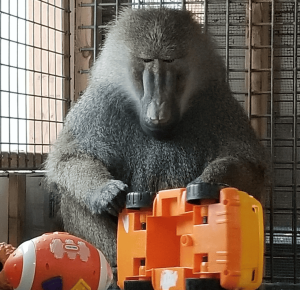
In December, the operator of Bervie Zoo in Kincardine, Ontario, pleaded guilty to three counts of shocking animal abuse. Geddes kept an olive baboon named Bruno and three peccary pigs in appalling, filthy conditions where they were found to be in distress. This guilty plea confirms what Animal Justice has been saying for years—that Bervie is perhaps Ontario’s worst roadside zoo, and should be shut down.
John Geddes originally faced over 21 counts of animal abuse after Animal Welfare Services (AWS) investigated Bervie Zoo in 2022, and discovered animals living in horrific conditions. Inspectors reported barns where the air was so thick with ammonia and feces that it burned their eyes and made it difficult to breathe, even through masks. Animals were found without adequate drinking water or ventilation, trapped in dimly lit and filthy cages.
AWS seized dozens of suffering animals, including porcupines, pigs, zebras, lemurs, and Bruno the baboon, who now lives at Story Book Farm Primate Sanctuary. Despite the on-going and well-documented distress of animals at Bervie Zoo, the prosecutor agreed to grant Geddes a suspended sentence where he will serve no jail time and will not pay a fine. Perhaps most shockingly, in such a severe case of animal cruelty, Geddes was not banned from owning animals in the future—as is commonly done for animal abusers. He will be allowed to continue operating the hellish zoo and imprison up to 75 exotic animals.
Credit: Story Book Farm Primate Sanctuary
Breakdown of Geddes’ Suspended Sentence Order
- 75 Exotic Animals: Geddes is still legally allowed to keep up to 75 exotic animals.
- Reporting Requirements: Geddes must report to AWS if he sells or rehomes any exotic animals, and report once per year how many animals he has. This is an irrelevant condition since AWS already has the right to obtain this information at any time.
- No Permanent Record: Because Geddes’ sentence was convicted under provincial legislation, he avoids a criminal record despite the seriousness of being found guilty of causing distress to animals.
“Financial Hardship” Used to Avoid Penalty
The Court and prosecutor went easy on Geddes because he claimed “significant financial hardship”. Geddes had previously been ordered by the Animal Care Review Board to pay for emergency medical expenses and ongoing care for the animals AWS was forced to seize. Failing to impose even a minimal fine or animal ownership ban in such an extreme case implies that businesses that choose to acquire, confine, and display animals for profit should be treated differently than others. This is an insult to the animals who have suffered, and a tragedy for those still trapped there.
A History of Suffering at Bervie Zoo
Animal Justice has been fighting to help the animals of Bervie Zoo since we first learned of the terrible conditions there in 2022. Every year since, we have returned to document a heart-wrenching cycle of distress and suffering. We have submitted numerous detailed complaints to AWS. Despite a mountain of evidence, AWS does not appear to have taken meaningful action to rescue the animals still at Bervie, and will not advise of any steps they have taken.
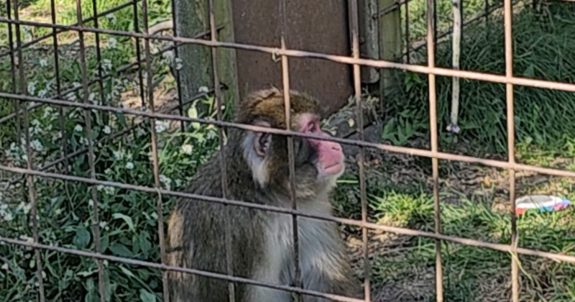
One of our top priorities is rescuing Boogie, a young macaque monkey who appears to remain at Bervie Zoo. We have documented Boogie trapped inside a small, barren enclosure for four years in a row, biting herself and spinning in circles—clear signs of profound psychological distress. We first saw Boogie in 2022 when we released Canada’s largest-ever zoo exposé, which uncovered widespread neglect across Ontario’s roadside zoos. Macaques like Boogie are highly intelligent, social, and emotionally complex beings. In the wild, they spend their days playing, grooming, and foraging for food across diverse landscapes. These activities are essential to their mental stimulation and social well-being—needs that zoos are incapable of meeting.

During our most recent visit to Bervie Zoo, the suffering was everywhere. Lions and tigers in cramped cages. Bears trapped in filthy, barren enclosures. A coatimundi who, according to a tour guide, had chewed off his own tail. Animals pacing in their enclosures repeatedly. Not only is Boogie still trapped at Bervie Zoo, it appears the zoo has acquired an additional macaque monkey.
The Failure of Zoo Oversight in Canada
Ontario is the roadside zoo capital of Canada because of lax legal oversight. There are no federal or provincial zoo regulations nor are there mandatory inspections to ensure animals in zoos are safe. Ontario requires a permit to build a patio in your backyard, but a zoo can open up and imprison exotic animals without any provincial license, permit, or oversight. Because the government has allowed these inadequate facilities to flourish, Ontario is in a roadside zoo crisis where authorities are essentially powerless to close down a zoo, even in cases of extreme animal distress and admitted abuse.
While Canadian zoos have been repeatedly exposed for appalling conditions, governments and law enforcement authorities almost never lay charges, even in egregious cases. In this rare instance of charges being laid for animal abuse at Bervie Zoo, the legal system still failed to deliver justice. Even in a case of extreme cruelty and a lengthy legal process, the result is devastating: a conviction with absolutely no meaningful penalty. This verdict sends a troubling message that even when the law is enforced, zoos with suffering animals will be allowed to continue operating.
Take Action
It’s time for the province to address the epidemic of roadside zoos in Ontario.
Join us in demanding mandatory zoo licensing, clear standards, regular unannounced inspections, meaningful penalties, and clear authority to shut down facilities where animals are in distress.