

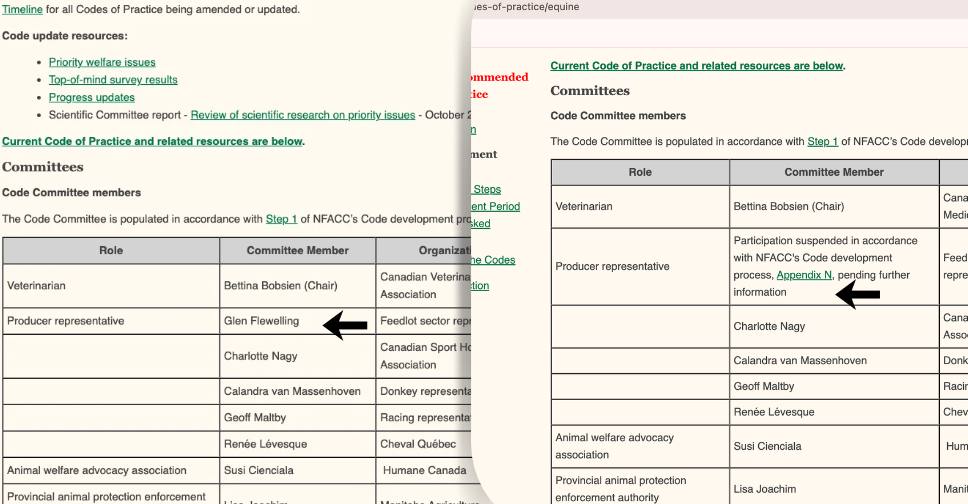
LACOMBE—An Alberta horse exporter has been suspended from the National Farm Animal Care Council (NFACC) Equine Code committee, following the release of drone footage by Animal Justice, Canada’s leading animal law organization, that appears to show terrified horses being hit in the face and jabbed and struck with sticks while being loaded for transport at his Alberta feedlot.
The October 18 drone footage recorded at Flewelling Ranches prompted Animal Justice to file complaints with the Alberta SPCA and the Canadian Food Inspection Agency (CFIA). The video shows horses being struck, at times on their faces, as they are loaded in the dark onto trucks bound for the Edmonton Airport, where they were flown to Japan to be fattened and slaughtered for meat.
NFACC is an animal industry-dominated organization that develops voluntary guidelines for the treatment of farmed animals. Canada has no national laws regulating how animals are treated on farms. Until his suspension, Flewelling Ranches owner Glenn Flewelling had direct influence over the standards for how horses are treated on feedlots like his own. Despite the suspension, the company continues to operate, regularly exporting horses for slaughter overseas.
“Pulling Mr. Flewelling off the committee is the bare minimum of action that should be taken in light of the violent handling of these horses,” said Kaitlyn Mitchell, lawyer and director of legal advocacy at Animal Justice. “This niche industry is rife with problems and these sensitive, intelligent animals deserve better than the cruelty they face during every step of their grueling trek to Japan.”
Each year, thousands of horses are flown from Edmonton and Winnipeg to Japan, where they are fattened and slaughtered to be eaten as a luxury delicacy. Investigations by Animal Justice and Japan-based Life Investigation Agency have repeatedly shown that the shipments regularly exceed the 28-hour legal limit for transporting horses without food, water, and rest.
Investigations have also shown that horses regularly collapse on these gruelling flights and even die during transport or in the hours and days after. Exporters regularly fail to report deaths and injuries during transport to the CFIA, despite legal requirements to do so.
The federal Liberals promised in 2021 to ban live horse exports for slaughter, but a bill to do so died when the last election was called. The government committed to following through on the promise during the 2025 election, but the flights continue.
Earlier this year, Flewelling Ranches withdrew a court case which attempted to keep records about apparent transport violations hidden from the public.
Contact: