

Each year, thousands of terrified horses endure gruelling flights from Edmonton and Winnipeg to Japan, where they are fattened and slaughtered for meat. These journeys are incredibly stressful, dangerous, and often deadly.
New data from the Japanese government, obtained by Animal Justice and Japan-based Life Investigation Agency, reveals that horse exports for slaughter continue to cause a shocking number of injuries and deaths. Animal Justice is releasing this disturbing data in a new report—Cruel Cargo: Hidden Injuries and Deaths in Canada’s Live Horse Export Trade.
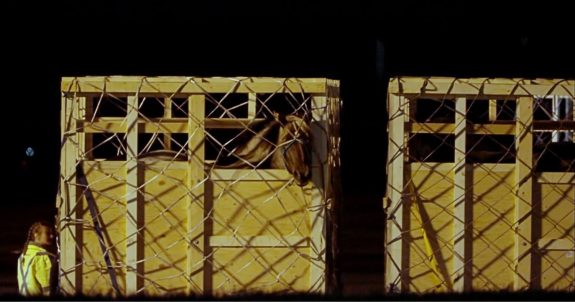
Horses exported for slaughter are first loaded onto trucks at Canadian feedlots, then driven to the airport where they are unloaded, crammed together into wooden crates, and loaded onto a cargo plane. They are given no food or water whatsoever during the journey. Shipments often contain 99 or more animals, leaving them crowded together with little oversight or care during the long overseas journey. Once they arrive in Japan, they are unloaded and trucked to a quarantine facility, before being fattened and eventually slaughtered so their flesh can be eaten as a delicacy in high-end restaurants.
Widespread Injuries & Deaths
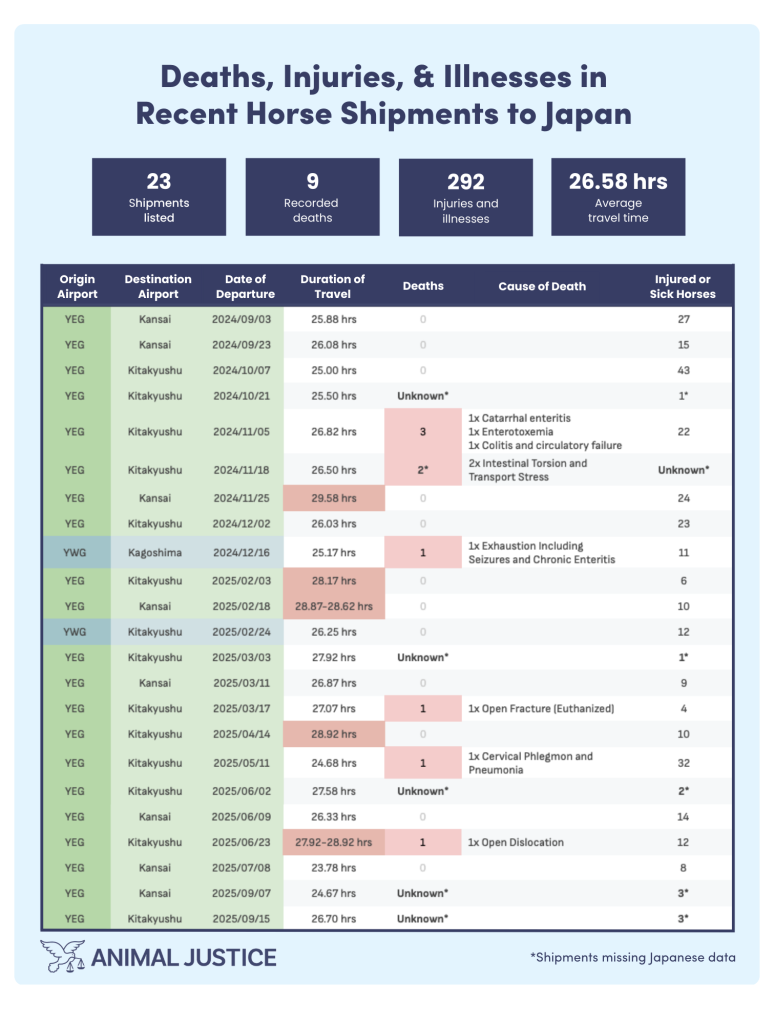
We analyzed records from September 2024 to September 2025, including numerous shipments between September 2024 and July 2025 for which both Canadian and Japanese data is available. During this period, at least nine horses died as a result of transport and at least 29 collapsed during flights. More than 290 other horses suffered serious injuries or illnesses including many horses with dangerous fevers, bleeding wounds, and even missing parts of ears and hooves. Disturbingly, Canadian exporters failed to report any of these injuries or deaths to the Canadian Food Inspection Agency (CFIA).
Two horses were euthanized shortly after landing due to severe leg injuries. Another horse could not stand and had to be removed from the plane, likely using a forklift. In another case, a horse was forced to stand despite significant bleeding. In all of these instances, exporters reported there were no injuries during the flights.
During this same period, at least five shipments appear to have exceeded the 28-hour legal limit for transporting horses without food, water, or rest.
Many of the handwritten Japanese quarantine notes were illegible and there were some shipments for which no Japanese data was available at all. So these disturbing numbers are likely just the tip of the iceberg when it comes to the full scale of suffering caused by this cruel practice.
The Government of Japan recently began to provide some information to the CFIA about the fate of horses after arrival—but much of the suffering documented in this report is missing in official reporting. Instead, most of the incidents were identified through handwritten veterinary notes recorded during the horses’ quarantine stay.
Click here to view the full report.
Legal Limits & Regulatory Failures
In June 2024 and September 2024, Animal Justice partnered with Life Investigation Agency in Japan to investigate what happens to horses once they arrive in Japan.
Our findings showed that horses regularly became injured during transport, suffered severe transport-related illnesses after landing, and sometimes died during the journey or in the hours and days that follow. None of these deaths or injuries were reflected in CFIA records.
The investigation also proved that most shipments exceeded the 28-hour legal limit that horses can be transported without food, water, or rest—all without legal action by the CFIA.
After the release of these damning exposés, the CFIA assured the public it would investigate these patterns of non-compliance and “take immediate steps” to protect horses. The agency modified exporters’ paperwork requirements and “reminded” them of their legal reporting duties. This new report shows that this improved oversight has not meaningfully improved conditions for horses. The only way to end this horrific and unnecessary suffering is to ban the export of horses for slaughter altogether.
Health Risks of Long-Distance Flights
Unfortunately, Canadian horses continue to suffer and die from these flights. During export, all horses face psychological distress, and the physical toll of these journeys is severe. Many horses develop “shipping fever,” a dangerous respiratory infection triggered by extreme stress and prolonged transport.
The data also reveals cases of:
- Severe dehydration: Horses lose vital fluids as they go without water while trucked from the feedlots, endure delays on the tarmac at the airport and lengthy flights, and are driven to quarantine facilities in Japan.
- Painful injuries: Horses crammed into small wooden crates often kick or step on one another. Japanese quarantine notes frequently describe horses with large bleeding lacerations, festering open wounds, and horses limping, dragging their back legs, and even unable to stand. In one example, a horse, still suffering from injuries at the end of the quarantine period, fell when being loaded into a transport truck and could not get up. Handwritten Japanese records of the incident are difficult to decipher, but mention the word “rope” followed by “standing.”
- Missing body parts: handwritten Japanese records show that at least two horses’ hooves came off, numerous horses had cracked hooves, and one was missing their outer ear. The cause of these extreme instances is unclear but it appears likely they were caused by physical trauma and stress during transport.
While horses endure gruelling conditions during exports overseen by the CFIA, the agency has taken care to ensure its staff remain comfortable on these trips. In an itinerary for a trip where CFIA representatives were present, the agency emphasized that staff should eat before leaving their hotel and bring snacks and water for the drive from a feedlot in Alberta to the airport.
Officers were assured they would be kept on the “comfortable” and “temperature controlled” second floor of the plane away from the horses on the first floor and fed during the flight. The CFIA also noted a desire to keep the representatives’ itinerary in Japan light the day after arrival in case “there is still residual trauma about flying and [to provide] time to recover before meetings.”
Take Action to End Horse Exports for Slaughter
The Liberal Party promised in 2021 to ban live horse exports for slaughter, but a bill to outlaw live horse export was delayed in the Senate, then died when the last election was called a year ago. The government has yet to make good on this commitment.
Meeting with your Member of Parliament is one of the most effective ways to help end this cruel trade! By requesting a meeting—either by phone or email—you can help put this issue back on the political agenda and urge your MP to support a ban. Click here to find your MP.
When speaking with your MP, ask whether they will urge the Prime Minister and the Minister of Agriculture to end horse exports for slaughter by amending the Health of Animals Regulations—a process that would ensure a ban is passed quickly, without the need for a new bill.
Together, we can ensure that no more horses are forced to endure this horrific journey.