


Last week, Animal Justice’s executive director Camille Labchuk testified before Ontario lawmakers on Bill 75. While expressing support, she also provided a roadmap to make this groundbreaking legislation even stronger. If passed, this bill would update the Animals for Research Act to end invasive experiments on cats and dogs. It would also ensure animals can be rehomed rather than killed after research.
Top-Secret Dog Lab Exposé Prompts Government Action
Momentum for Ontario’s Bill 75 follows Animal Justice’s 2025 dog testing exposé that captured the attention of Premier Doug Ford. He was so appalled by the findings that he pledged to end research on dogs and cats.
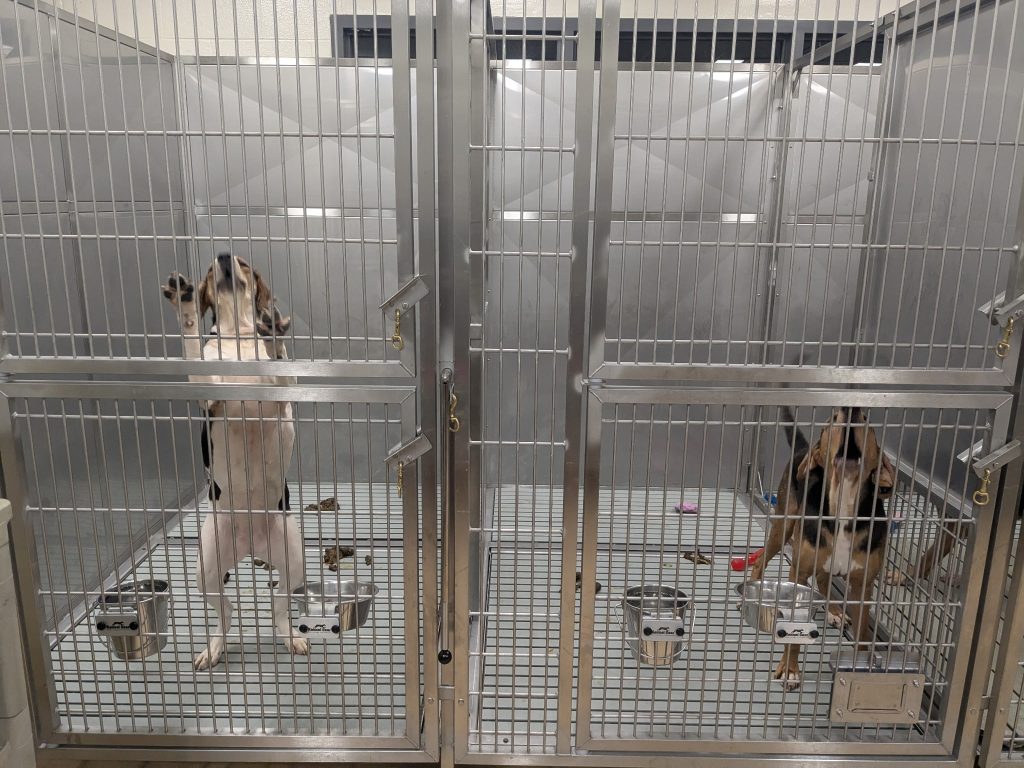
Animal Justice worked with two brave whistleblowers to expose a secret dog lab at St. Joseph’s Hospital in London, Ontario. Inside, researchers subjected dogs to painful and invasive heart experiments before killing and discarding them.
The suffering went beyond the procedures. Dogs—as young as eight months old—were confined to barren, metal-barred cages with little enrichment or social interaction. Many developed behaviours indicative of psychological distress, known as stereotypies. They paced through their own waste, submerged their faces in water, or sucked their tails raw.
How Ontario Can Strengthen Bill 75
This bill is a great step forward, but there is an important opportunity to strengthen it. Animal Justice is calling for key amendments to ensure the law meaningfully protects animals.
| Bill 75 Provisions | Proposed Amendments |
| Banning the use of dogs and cats (and potentially other animals in the future) in “invasive medical research”. | Clarify that the new law prohibits all invasive testing, not just invasive medical research. Medical studies are among only five categories of research in which animals are used. Others include product development and regulatory toxicity testing—the most harmful use of animals in Canadian science. |
| Allow invasive research on dogs and cats only for veterinary purposes. | Prohibiting all experiments on dogs, cats, and other prescribed animals that cause severe pain at or above the pain tolerance threshold of anesthetized conscious animals. |
| Allowing dogs and cats obtained from pounds to be rehomed at the end of experiments. | Mandatory rehoming of suitable animals (like dogs and cats) after experiments, or sending them to sanctuaries (like primates and pigs) rather than killing them. |
| No amendments to s 1.1 of the Animals for Research Act, which excludes all animals at research and supply facilities from the protections set out in Ontario’s animal welfare law. | Repeal s 1.1 of the Animals for Research Act such that the Provincial Animal Welfare Services Act applies to animals used in research. |
Additionally, we’re urging the government to repeal parts of the “pound seizure” sections of Ontario’s current law, which require pounds to sell lost or abandoned dogs and cats to experimenters.
The Sad State of Animal Testing in Canada
Canada continues to lag behind other countries in transitioning to modern, animal-free research methods. Newly released data reveals that 3.7 million animals were used in animal testing across Canada in 2024—an alarming 18.5 percent increase from 2023. The experiments conducted were also more painful, with more animals used in procedures causing severe distress.
These cruel, outdated tests happen in a regulatory vacuum. Canada has no federal legislation regulating animal welfare in scientific research. Instead, the Canadian Council on Animal Care (CCAC)—a non-profit organization with no legal authority, dominated by animal experimenters—issues voluntary guidelines for the use of animals in research.
Without enforceable laws, rigorous review of experiments, and independent enforcement, harmful experiments continue with little accountability.
Beyond Animal Testing in Canada
Ontario has the opportunity to be a leader in cutting-edge, animal-free science. But meaningful progress requires investment in alternatives. Canada’s only national centre dedicated to developing and validating non-animal testing methods was recently forced to shut down due to a lack of public funding.
Premier Ford should work with the federal government to restore this critical centre and support innovation in animal-free research. Doing so would not only reduce animal suffering, but establish Canada as a global leader in modern, humane science.
Join us in thanking Ontario for its leadership in moving to end cruel animal experiments, and ask the province to include amendments to Bill 75 that will prevent millions of animals from enduring needless pain and suffering.