

Update: The comment period is now closed. Take action here to strengthen Bill 75.
Until January 9, 2026, the Ontario government is inviting public comments on a bold and compassionate proposal to pass regulations to advance a ban on cruel experiments on dogs and cats.
Cruel Dog Experiments Exposed
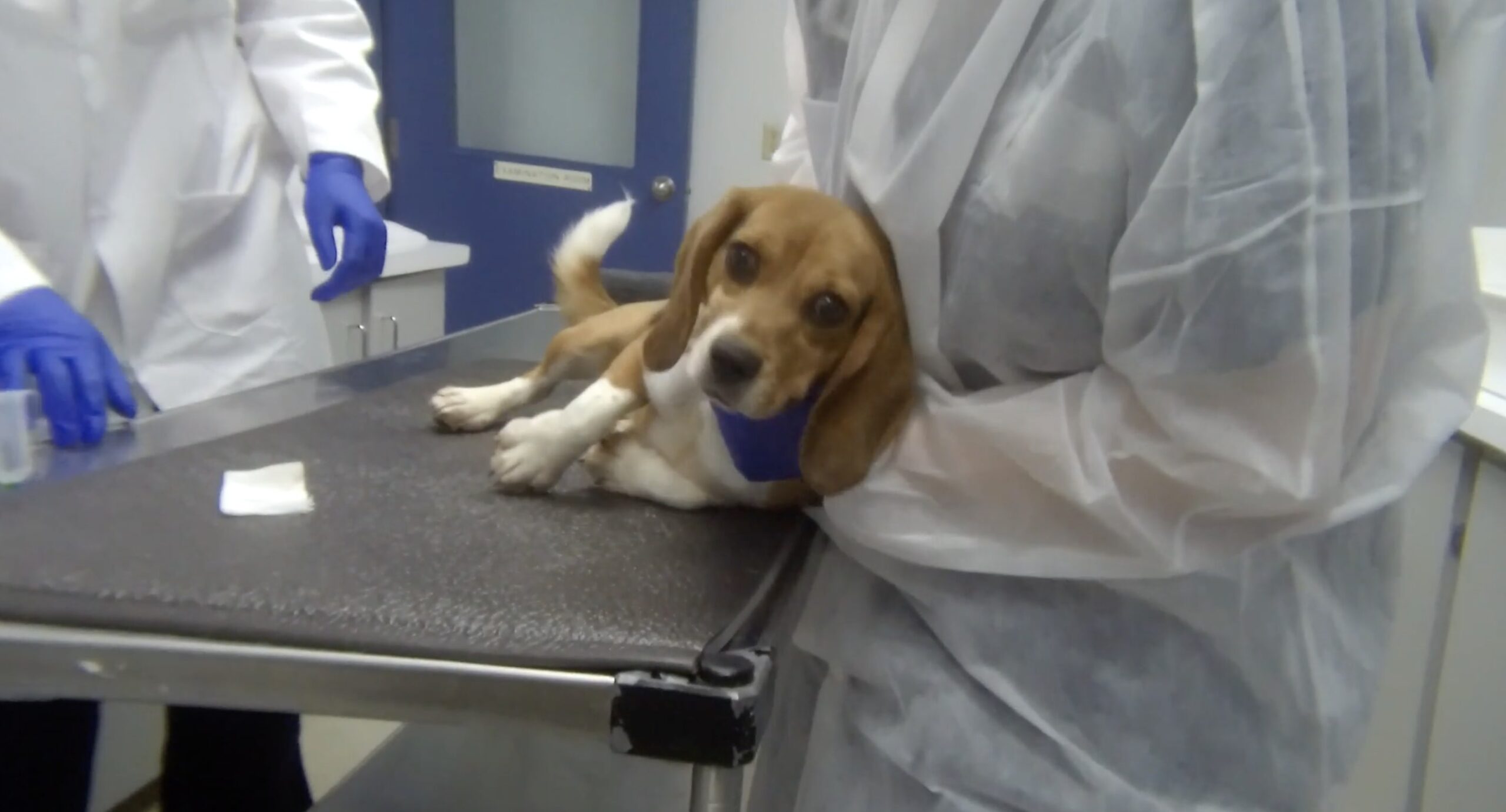
Premier Doug Ford promised to end research on dogs and cats last year after Animal Justice helped expose a secret dog lab at St. Joseph’s Hospital in London. Whistleblowers, whose collaboration with Animal Justice led to a bombshell Investigative Journalism Bureau story, revealed that the dogs were subjected to invasive and painful heart experiments before being killed and discarded. Dogs at St. Joseph’s Hospital were confined in cages and forced to endure painful, hours-long heart attacks. Many died during the experiments, while others were forced to endure long and painful recoveries only to be killed once they were brought back to health.
The whistleblowers shared heartbreaking details about dogs like Salt—a gentle, affectionate puppy who formed a close bond with her cage-mate, Sugar. Sugar died during her heart attack experiment, leaving Salt to suffer alone after her own surgery. Whistleblowers tried to comfort Salt as she whimpered, and exhibited troubling stereotypic behaviours like repeatedly submerging her face in her water dish. About two months later, Salt was killed and her body was stuffed into a barrel with other dogs for disposal.


Sugar and Salt, best friends and animal testing victims at St. Joseph’s Hospital.
The revelations led to the shuttering of the cruel dog research program. Sadly, pigs, rats, and other animals continue to endure painful experiments at this facility.
Proposed Regulations a Huge Step Forward for Animals
Ontario took the first groundbreaking step with Bill 75, which would update the Animals for Research Act to end invasive experiments on cats and dogs, as well as encouraging post-research adoption of animals. The public has until January 9, 2026 to comment on some important regulatory changes that accompany the bill.
The regulatory proposal includes the following key measures:
- Prohibiting “invasive medical research”: Ontario is proposing to ban the use of dogs and cats (and potentially other animals in the future) in experiments that involve surgery, exposing animals to harmful drugs or chemicals, or causing moderate to severe pain or distress.
- An exception to allow invasive research on dogs and cats for veterinary purposes.
- Prohibiting routine killing of dogs and cats at the end of experiments. Euthanasia would be allowed for “humane reasons” only.
- Oversight of research project proposals by Animal Care Committees (ACCs) at research facilities. This includes ensuring researchers prioritize alternatives to animal methods and explore ways to rehome animals at the end of experiments.
Room for Improvement
Ontario’s proposed legislation lays a strong foundation to protect dogs and cats in labs, but there are several key ways in which the proposal should be strengthened:
- The prohibition on “invasive medical research” should include experiments where animals used are kept in conditions that can cause distress or fail to satisfy their basic social and biological needs. For instance, keeping dogs confined in kennels for 23 or more hours each day—as occurred at the secret dog lab at St. Joseph’s Hospital—is cruel and should also be banned, regardless of the nature of the experiment they are being used for.
- Greater transparency and accountability by ACCs, which are often made up of animal researchers and operate with little government oversight. To ensure ACCs effectively scrutinize experiments involving animals and require adoption rather than killing at the end of experiments, oversight is needed, and the public should have access to information about the experiments that these Committees approve.
- Stronger requirements for rehoming suitable animals (like dogs and cats) after experiments, or sending them to sanctuaries (like primates and pigs) rather than killing them.
- Prohibiting all experiments on dogs, cats, and other prescribed animals that cause severe pain at, or above, the pain tolerance threshold of anaesthetized conscious animals.
In addition to passing new laws, Ontario can and should be a hub for cutting-edge, animal-free science. Canada’s national centre dedicated to the development and validation of non-animal testing methods was located at the University of Windsor in Ontario, but was recently forced to close its doors due to a lack of public funding. Premier Ford should work with the federal government to re-open the centre and establish Canada as a global leader in the shift to modern, animal-free science.
Amending the Animals for Research Act
Bill 75 will be studied and debated after the legislature returns in March, and Animal Justice will be urging the government to strengthen the bill in several key ways, including:
- Clarifying that all invasive experiments on dogs and cats are prohibited, not just those conducted for medical research. Toxicity testing for chemicals and pest control product testing are among the most harmful uses of animals in Canadian science.
- Requiring experimenters to prioritize adoption and rehoming of animals where possible.
- Repealing part of the law stating that Ontario’s general animal welfare laws do not apply to animals used in research. Animals used in research should benefit from the same basic protections as all other animals in the province.
- Ending the practice of “pound seizure”, where animal experimenters can buy lost or abandoned dogs and cats from municipal pounds.
Take Action Now
By taking steps to end the cruel and outdated use of dogs and cats in experiments, Ontario is setting an example for other provinces to follow. Canadians see these animals as family, and there is little social license left for research that causes them fear, pain, and death—especially given that there are an increasing number of non-animal research methods that can produce superior data.
Please take a moment to thank Ontario for showing leadership toward ending cruel experiments on animals and urge the province to draft regulations that protect dogs, cats, and other animals from the pain and suffering that Salt and the hundreds of other dogs killed at St. Joseph’s were forced to endure.