
Key Takeaways:
- Over 3.93 million animals were used in Canadian experiments in 2025—an increase of more than 200,000 animals compared to 2024.
- Experiments using cats, birds, pigs, and amphibians dramatically increased from 2024 to 2025.
- Together, fishes (1.83M) and mice (1.18M) accounted for more than 76 percent of all testing subjects in 2025.
- Animals subjected to Category E experiments—causing severe pain near or above the pain threshold—rose by over 6,000, to 104,912 animals.
- Canada has no federal laws regulating animal testing. Oversight relies on the non-profit Canadian Council on Animal Care (CCAC), which has no law enforcement power. Many private labs don’t participate in its voluntary oversight.
- While Ontario passed a historic ban on most invasive cat and dog experiments, overall nationwide progress toward animal-free research methods remains slow.
New data on animal testing in Canada shows that more than 3.9 million animals were experimented on in 2025—an increase of over 200,000 from 2024. There was a sharp rise in cats, pigs, birds, and amphibians used in experiments, and more animals were subjected to severe pain.
Recently, Ontario passed landmark legislation to ban most invasive medical experiments on cats and dogs, effective January 1, 2027. Despite this significant victory for animals in labs, the 2025 figures paint a troubling picture of Canada’s lack of progress in protecting animals from cruel experiments and transitioning to modern, animal-free research methods.
Animal Suffering in Labs Is on the Rise
Data from 2025 shows that 3,935,094 animals were used in research, testing, and teaching across Canada. Most of them were fishes and mice, making up more than 76 percent of all animals used. Birds, cows, rats, amphibians, and pigs were also used in large numbers, while dogs, cats, rabbits, and non-human primates together accounted for 37,355 animals used in experiments.
Sadly, experiments on many species went up. More than 11,000 additional cats, nearly 20,000 more pigs, over 70,000 more birds, and more than 16,000 additional amphibians were used compared to the prior year.
Many Canadians are shocked to learn that the federal government does not regulate or oversee animal experiments. Instead, the country relies on the Canadian Council on Animal Care (CCAC), a non-profit organization with no law enforcement powers.
The CCAC is dominated by animal experimenters and provides annual reports on institutions that choose to work with it.
Unfortunately, CCAC data doesn’t fully capture the scale and impact of animal testing in Canada. Because participation in the CCAC is voluntary for labs that don’t receive government funding, private labs can slip through the cracks, causing large gaps in data.
| Type of animal | Number of animals used in 2025 |
| Fishes | 1,838,204 |
| Mice | 1,180,447 |
| Cows | 403,289 |
| Birds | 173,891 |
| Rats | 94,884 |
| Amphibians | 92,221 |
| Pigs | 42,035 |
| Other animals | 41,477 |
| Cats | 16,143 |
| Other rodents | 12,343 |
| Reptiles | 10,669 |
| Dogs | 9,944 |
| Non-human primates | 8,889 |
| Guinea pigs | 8,279 |
| Rabbits | 2,379 |
| Total | 3,935,094 |
More Animals Used in the Most Painful Experiments
While the CCAC claims to be trying to reduce the number of animals used in research and to lower pain and distress during experiments, the data tells a different story.
The CCAC categorizes experiments according to their level of invasiveness, ranging from Category B, which involves little or no discomfort, to Category E, in which experiments “cause severe pain near, at, or above the pain tolerance threshold of unanesthetized conscious animals.”
Last year, Category E experiments surged by nearly 6.5 percent, from 98,441 in 2024 to 104,912 in 2025. That means more animals are enduring extreme levels of pain and distress.
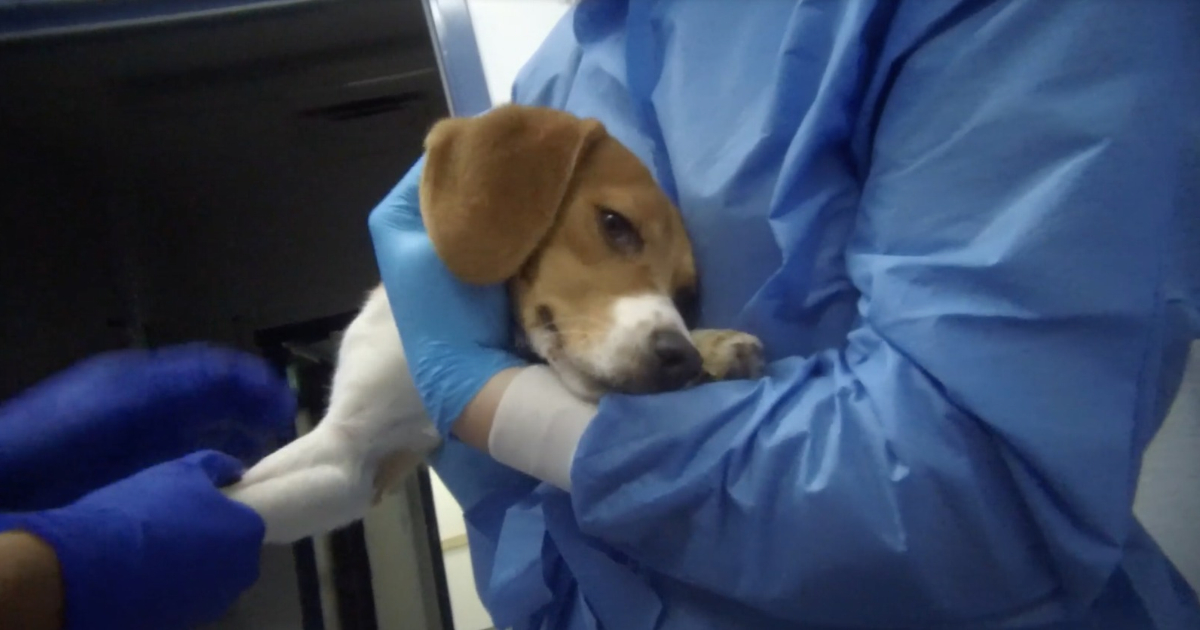
Nucro-Technics, Canada’s largest contract research lab, was recently exposed for disturbing experiments on beagles, consistent with Category E procedures, according to a report by the Investigative Journalism Bureau (IJB) and undercover footage from Last Chance for Animals.
The Toronto-based lab forcibly fed toxins to dogs by shoving tubes down their throats and tying their legs together to prevent them from struggling during invasive tests. The secretly-recorded footage also showed dogs being handled roughly during experiments before being killed and disposed of like garbage.
Canada’s Lack of Oversight Hurts Animals
Canadian laboratories need to be held to account through strong, enforceable laws, rigorous review of experiments, and government oversight. It’s time for Canada to give up on its hands-off approach to animal experiments.
In 2023, Canada released a national plan to phase out toxicity testing on animals by 2035. Yet Canada’s only national centre dedicated to innovative, animal-free science—the Canadian Centre for Alternatives to Animal Methods—was forced to shut down due to lack of federal funding. This is a huge blow to animal-free science, leaving Canada as an outlier while countries around the world invest in this important and emerging field.
Over 90 percent of new drugs shown to be safe and effective in animal tests fail in human clinical trials. Non-animal testing methods are often more affordable, deliver more reliable results, and spare animals from heartbreaking suffering.
It’s time for Canada to do more to end cruel and unnecessary experiments and accelerate the transition to modern, cruelty-free research.
Banner: Andrew Skowron | Otwarte Klatki | Flickr
Frequently Asked Questions:
How many animals were experimented on in Canada in 2025, and which species were most common?
In 2025, a total of 3,935,094 animals were used in research, testing, and teaching across Canada—an increase of more than 200,000 animals from 2024. Fishes (1.83 million) and mice (1.18 million) made up the vast majority, representing over 76 percent of all testing subjects. However, this number does not account for private labs, which continue to operate without oversight.
Are lab animals in Canada subjected to painful procedures?
Yes. Category E procedures are classified by the Canadian Council on Animal Care (CCAC) as experiments causing severe pain near, at, or above the pain tolerance threshold of conscious animals. In 2025, the number of animals subjected to Category E procedures rose by over 6,000 to reach 104,912.
Does the Canadian government regulate animal testing in laboratories?
No, the federal government does not regulate or oversee laboratory animal testing. Instead, Canada relies on the Canadian Council on Animal Care (CCAC), a non-profit organization dominated by animal experimenters, which has no law enforcement power. Because participation in the CCAC is voluntary, private laboratories are not required to report their figures, leaving many animals unaccounted for.
What steps is Canada taking to phase out or reduce animal testing?
While progress across the country is slow, key legislative steps include Ontario’s landmark ban on invasive experiments on cats and dogs starting January 1, 2027. Additionally, Canada released a national plan in 2023 aiming to phase out toxicity testing on animals by 2035.