

Lire la version française ici.
Key Takeaways:
- Animal Justice has filed legal complaints over Quebec dairy advertisements that depict cows roaming freely on green pastures, arguing that the campaign could mislead consumers about how dairy cows are typically housed.
- More than 70 percent of Quebec dairy barns use tie-stall systems, where the vast majority of cows are tethered by the neck in individual stalls and have severely restricted opportunities to walk, socialize, graze, or go outdoors.
- Animal welfare matters to consumers: 81 percent of Quebecers surveyed said they are concerned about farmed animal welfare, while a separate federal survey found that 66 percent of Canadian grocery shoppers would pay more for animal-based foods produced more humanely.
- Canada largely relies on industry-developed codes of practice rather than binding, comprehensive on-farm animal welfare laws. The Dairy Code of Practice continues to permit tie-stall housing and does not require cows to have outdoor access.
- Animal Justice is calling for greater transparency in food advertising and stronger, legally enforceable protections for farmed animals instead of relying on industry self-regulation.
Animal Justice has filed legal complaints against Quebec dairy industry ads that paint a false picture of life for Quebec dairy cows. The complaints were submitted directly to Canada’s Competition Bureau, the Canadian Food Inspection Agency (CFIA) and Quebec’s Office de la protection du Consommateur. Animal Justice also assisted concerned citizens with filing complaints with Ad Standards Canada.
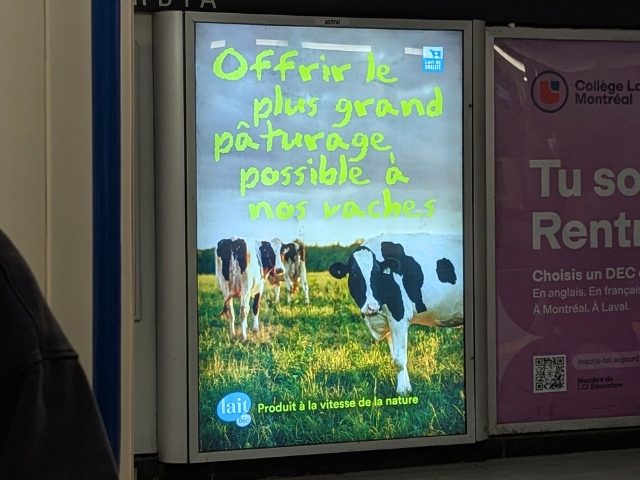
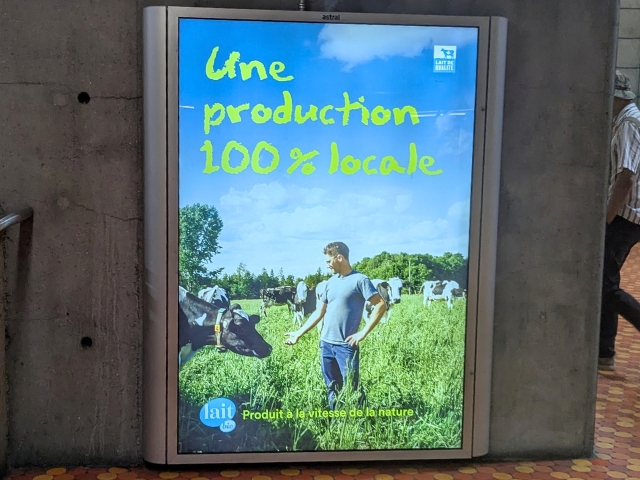
The Producteurs de lait du Quebec (PLQ) advertisements appear in high-traffic public spaces across Montreal, including Montreal metro stations. They depict happy-looking cows roaming freely across green fields alongside the prominent slogan, “Offrir le plus grand pâturage possible à nos vaches” (“Offering the largest possible pasture to our cows”). Smaller text on the ad says, “Produit à la vitesse de la nature” (“Produced at the speed of nature”).
This ad includes the PLQ’s logo, featured prominently, and a tiny logo on the bottom left-hand corner that says “Bio” in blue text, which could indicate that it relates to organic dairy. However, the legal complaint explains that these limited details and small “bio” wording fail to clarify the true scope of standard dairy farming.
When considering whether an ad is unlawfully misleading to the public, regulators must take into account the overall impression it creates based on text and imagery—not a narrow view based on technicalities and disclaimers. As a result, Animal Justice believes the campaign may lead consumers into thinking dairy cows generally live in pastures.
The Hidden Reality for Quebec Dairy Cows
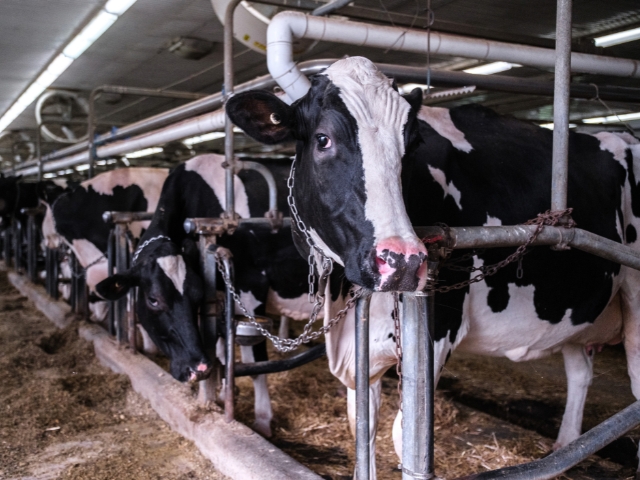
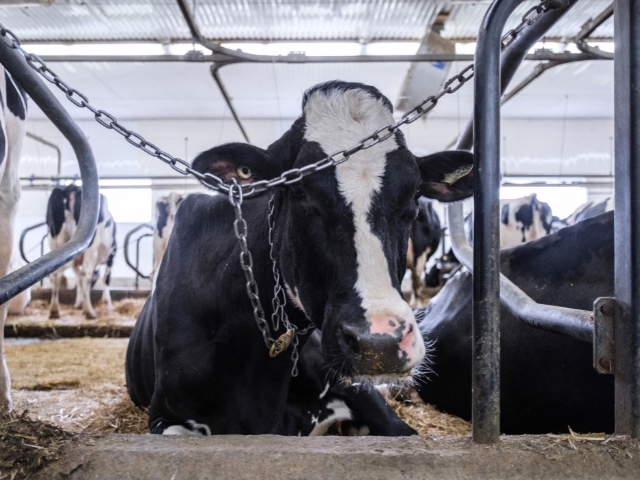
These ads give consumers the impression that Quebec dairy cows enjoy access to open pastures and fresh grass. In truth, over 70 percent of dairy barns in Quebec confine cows to tie-stalls.
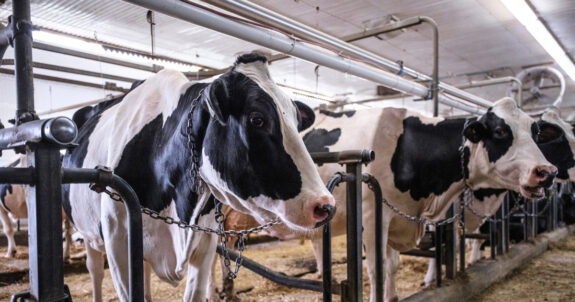
In a tie-stall system, cows are tethered by their necks in narrow individual stalls for months—or even their entire lives. Heavy chains or collars restrict their movement, preventing them from walking, grazing outdoors, socializing naturally, or even turning around.
Far from living “at the speed of nature,” these gentle animals face severe physical and psychological strain from continuous confinement, and may never even have access to the outdoors. Framing this system as an idyllic, green local practice masks the systemic cruelty of confinement and deprivation faced by dairy cows forced to live in tie-stalls.
Misleading the Public on Animal Welfare
This deceptive campaign directly influences Quebec consumers. The way dairy farms house cows in Quebec matters deeply to local shoppers. In fact, a survey conducted by Léger for Quebec’s Ministry of Agriculture, Fisheries and Food found that 81 percent of Quebecers are concerned about farmed animal welfare.
Polling consistently shows that most consumers will even pay more for higher-welfare animal products. For instance, a 2023 survey by Agriculture and Agri-Food Canada revealed that 66 percent of Canadian grocery shoppers would pay extra for animal-based foods produced with less cruel methods.
Imagery of cows roaming free in pastures contributes to an overall impression that cows on Quebec dairy farms are kept in humane conditions. This deceptive marketing directly undermines consumer protections meant to improve marketplace accuracy and discourage misleading claims.
The Illusion of Standards: Farmed Animals & Industry Self-Regulation
This ad campaign highlights a much broader, structural crisis facing animals in Canada. Unlike companion animals, farmed animals have virtually no direct legal protections governing their day-to-day welfare on farms. As a result, farms subject millions of animals to extreme confinement, deprivation, and painful bodily mutilations without legal oversight or penalty.
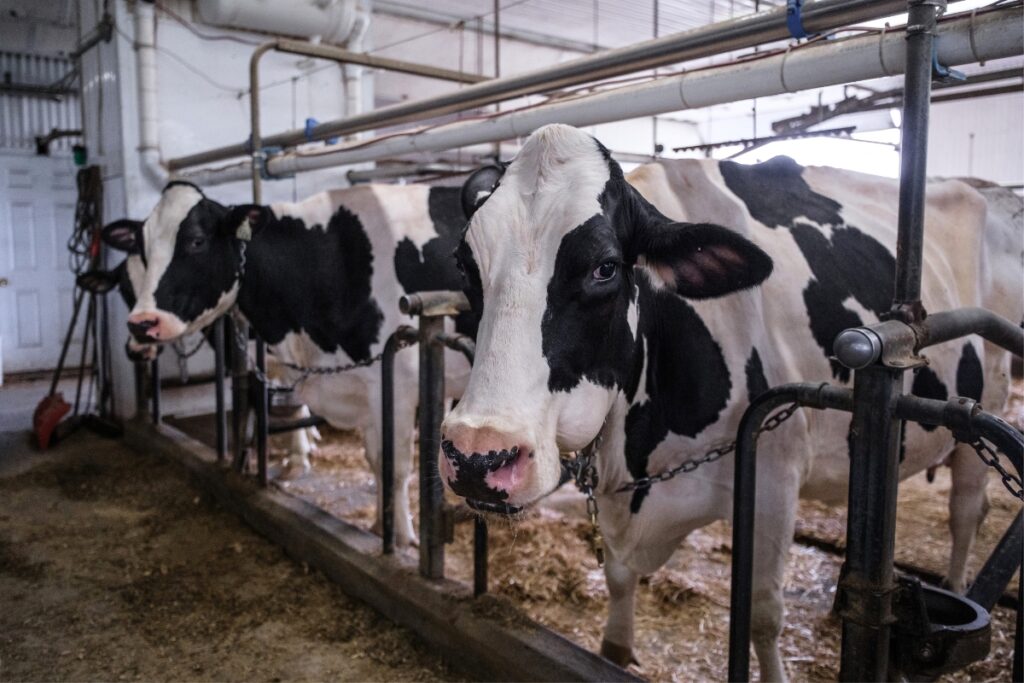
Dairy farms can keep cows chained for their entire production cycle because the dairy industry writes its own rules. Instead of enacting binding welfare laws, governments rely on voluntary codes of practice and industry self-regulation via the National Farm Animal Care Council (NFACC).
These non-binding guidelines in the Dairy Code of Practice allow cows to be chained for their entire production cycle. The Dairy Code says that as of 2027 a cow can’t be tethered for her entire “production cycle” (i.e., from one forcible impregnation and birth to the next) and should have “sufficient regular opportunity for freedom of movement.” But this vague language means farmers can still keep cows tethered for nearly the entire day. There’s also no requirement that tethers be of any particular length—merely a recommendation that they be at least one metre long. The Dairy Code also lets farmers keep cows inside barns their entire lives—no outdoor access is required.
Demand Legal Accountability for Farmed Animals
Consumers deserve the truth about where their food comes from, and animals deserve real legal protections instead of empty voluntary guidelines. We cannot rely on industry self-regulation via the NFACC to protect animals from systemic abuse.
Banner: Ira Moon | Animal Justice | We Animals
Frequently Asked Questions
Why did Animal Justice file complaints about Quebec dairy ads?
Animal Justice filed complaints over advertisements appearing in public spaces across Quebec that depict happy cows roaming freely on green pastures. We argue that the ads could mislead consumers about how dairy cows are typically housed in Quebec and create an inaccurate impression of animal welfare in the dairy industry in the province.
Complaints were submitted to Canada’s Competition Bureau, the Canadian Food Inspection Agency (CFIA), and Quebec’s Office de la protection du consommateur. Animal Justice also assisted concerned citizens with filing complaints with Ad Standards Canada.
How are most dairy cows housed in Quebec?
More than 70 percent of dairy barns in Quebec use tie-stall systems. In these systems, cows are tethered by their necks in individual stalls, severely restricting their ability to walk around, socialize naturally, graze, or explore their surroundings.
Some cows may spend most of their lives tethered and may have little or no access to the outdoors.
Why could the dairy ads be misleading?
The advertisements prominently show cows roaming on large, green pastures alongside messaging about offering cows as much pasture as possible. While a small “Bio” logo may indicate that the ads relate to organic dairy, Animal Justice argues that this limited disclosure is not clear enough to prevent consumers from getting the impression that the imagery represents Quebec dairy farming more broadly.
Do dairy cows in Canada have to be given outdoor access?
No. Canada’s voluntary Dairy Code of Practice does not require dairy cows to have access to the outdoors.
As of 2027, the code says that a cow can’t be tethered for her entire “production cycle” (i.e., from one forcible impregnation and birth to the next) and should have “sufficient regular opportunity for freedom of movement”. But this vague language means farmers can still keep cows tethered for nearly the entire day. There’s also no requirement that tethers be of any particular length—merely a recommendation that they be at least one metre long.
Are Canada’s dairy welfare standards legally binding?
No. The Dairy Code of Practice is not a law. It was developed through the National Farm Animal Care Council (NFACC), an industry-led body that produces voluntary codes of practice for the care and handling of farmed animals.
What is Animal Justice asking for?
Animal Justice is calling for truthful, transparent advertising about how farmed animals are treated and stronger legal protections for animals on farms.
Animal Justice is calling for governments to adopt strong, legally enforceable farmed animal welfare standards rather than relying on industry self-regulation and voluntary guidelines.