

In August 2025, Animal Justice exposed shocking conditions at a British Columbia egg farm. This farm was contracted by Golden Valley, a major supplier for grocery chain Sobeys, owned by the retail conglomerate Empire Company. Now, a new undercover investigation reveals similar disturbing conditions at Burnbrae Farms. As Canada’s largest egg producer, Burnbrae is a major supplier of eggs for Farm Boy in Ontario, yet another chain of stores under the Empire banner.
Farm Boy markets itself as a “farm-to-table” grocery chain, posing as a local, premium alternative to big-box supermarkets. In reality, most of the eggs on Farm Boy shelves come from Burnbrae Farms. Sadly, new footage shows widespread animal suffering inside Burnbrae’s massive industrial egg barns. This includes extreme confinement in cramped cages, hens with untreated injuries, and violent handling practices.
Animal Justice’s new investigation exposes a troubling gap between the idyllic, sustainable brand Farm Boy presents to shoppers, and the heartbreaking reality faced by hens in its supply chain. This mismatch reflects a broader pattern of animal cruelty hidden behind misleading marketing claims and empty promises in Canada’s grocery and egg industries.
Watch the Video
The footage reveals:
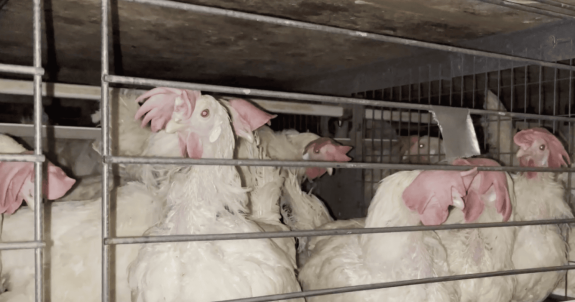
- Intensive Confinement: Tens of thousands of hens living in severe confinement and distress.
- Untreated Injuries: Birds suffering from prolapses, broken legs, and dislocated hips.
- Neglect: Hens dying slowly from starvation or becoming trapped in equipment.
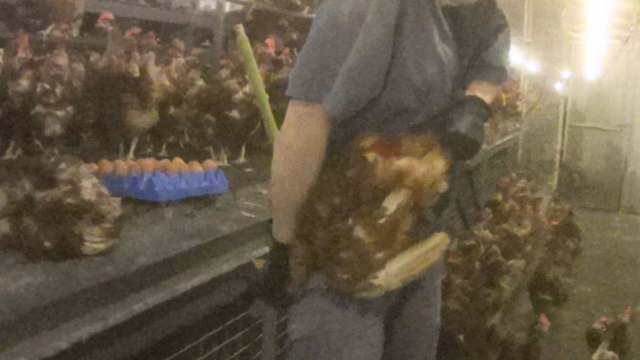
- Rough Handling: Workers carrying hens by their wings and throwing them.
- Invasive Procedures: Blood draws performed without pain relief.
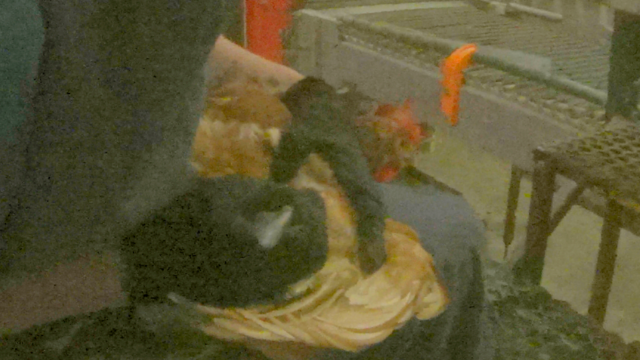
- Violent Killing: Workers killing sick hens by breaking their necks manually.
Life & Death Inside Burnbrae Farms
Equipped with a hidden camera, an undercover investigator spent weeks working inside Burnbrae’s primary site in Lyn, Ontario: a mega-farm egg operation that doubles as the company’s headquarters.
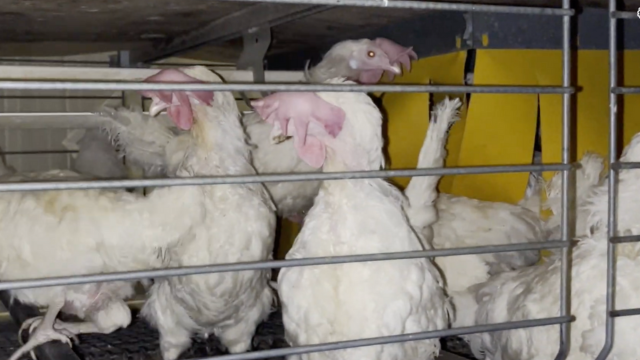
Throughout the investigation they documented tens of thousands of hens confined in cages. The conditions would deeply disturb most consumers. Many birds suffered from a range of serious and often untreated health problems, including fatty liver disease, prolapses, broken legs, and dislocated hips. Others were found trapped in equipment, slowly dying from starvation, or killed by obstructed eggs—cruel and painful outcomes that are typical in industrial egg production.
The investigation documented workers routinely subjecting hens to rough handling. The investigator observed birds being carried and restrained by their wings, and then cut open with blades for blood draws for disease testing, all without pain relief. Once a hen became too sick or injured to be productive, workers killed her by hand. They would violently pull her head until her spinal cord disconnected from her brain. Prior undercover investigations in 2024 and 2025 revealed that on modern egg farms, animal suffering is not an exception, but a routine part of daily operations.

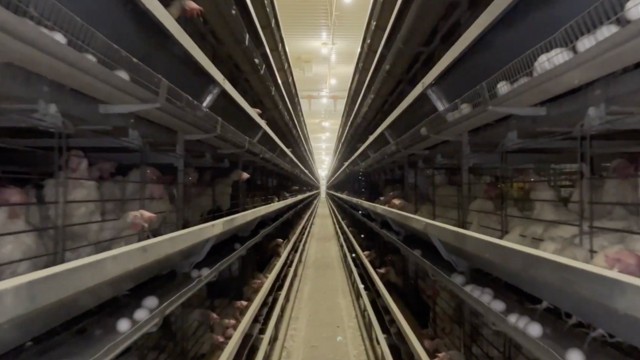
Cage Confinement on an Industrial Scale
The Burnbrae Farms facility in Lyn, Ontario, is one of the largest egg farms in Canada. The site has eight barns, with more being built. Four barns are free-run, and four use battery cage systems—three with conventional cages and one with so-called “enriched” cages. In total, hens in this facility produce approximately 300,000 eggs per day.
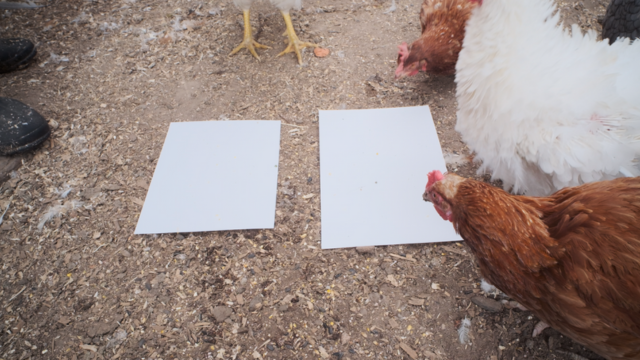
Conditions inside these barns are extreme. In conventional battery cages, each hen has only about the space of a single letter-sized sheet of paper, with approximately six birds confined to each cage. Two of these barns house approximately 60,000 hens each, while a third contains about 80,000 birds. The average Canadian egg farm houses 23,000 hens, but on this Burnbrae mega-farm, that figure is nearly doubled—in each of its eight barns.
The Truth About “Enriched” Cages
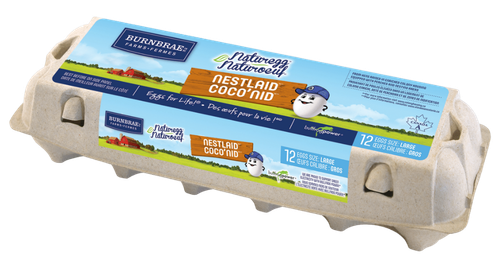
Another barn uses “enriched” battery cages—sometimes referred to as “furnished” or “colony” cages by industry—confining roughly 46,000 hens, around 20 birds per cage, stacked five levels high. Commonly marketed under Burnbrae’s “Nestlaid” label, “enriched” cages are still cages. They may add minimal features like a perch or scratching pad, or a plastic flap and call it a “private nesting area.” These furnishings are insufficient for hen welfare, and fail to eliminate extreme confinement.
Cages confine over 70 percent of hens at this Burnbrae farm, totalling roughly 246,000 birds. These conditions crowd hens together, preventing them from moving freely or fully spreading their wings. The staggering scale of cage use at this facility is equivalent to every one of Toronto’s quarter million cats being crammed into cages—all on this one farm.
Marketing That Misleads Consumers
Farm Boy mostly stocks its shelves with Burnbrae eggs. Yet its stores are filled with images of grassy fields, plush toy chickens with a clucking soundtrack, and egg cartons branded with names like “Naturegg” and “Nestlaid”. Pastoral displays reinforce the illusion of humane, outdoor farming. But Animal Justice’s undercover footage exposes the truth: cages trap these birds in a life of suffering. They endure illness, injury, and routine harm and neglect.
Don’t let the ‘local’ branding fool you. Farm Boy belongs to Empire Company, the same conglomerate behind Sobeys, FreshCo, Safeway, and Longo’s. Together, these chains dominate a fifth of the Canadian grocery market, proving that Farm Boy is anything but a small, local alternative. Empire’s brands have repeatedly failed to meet cage-free commitments to consumers and investors. Sobeys has already faced nationwide protests following the first 2025 investigation that exposed cruelty at one of its BC egg suppliers.
This new investigation confirms a systemic problem: from Sobeys to Farm Boy, major Canadian food companies still support confining hens in cruel conditions behind closed barn doors. These companies are defaulting on their longstanding public pledges to get rid of all cages. And, they use misleading marketing designed to hide the truth from customers.