

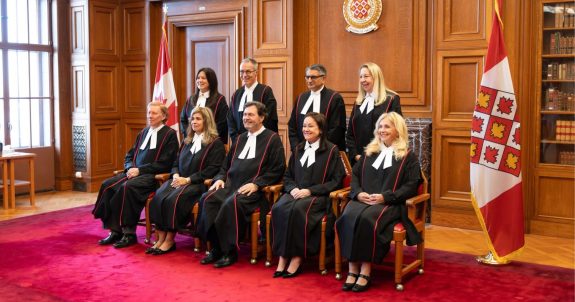

Canada’s highest court has turned a page on an outdated tradition. The Supreme Court is ditching its fur-trimmed robes in favour of a new, modern look.
For the first time in nearly half a century, the Supreme Court of Canada has redesigned its ceremonial robes. The old red “Santa Claus” robes, commissioned in 1979 by then Chief Justice Bora Laskin, featured white ermine fur trim. Each robe used the pelts of dozens of ermines. The animals were apparently raised and killed at a fur farm near Kingston, Ontario. This fall, Chief Justice Richard Wagner announced that those fur-trimmed robes have now been retired for good.
“The Speech from the Throne on May 27 was the last time my colleagues and I will have worn those robes, with the white [ermine] fur,” Chief Justice Wagner said. “This year, for the 150th anniversary, the moment has come to have new robes that better reflect Canadian identity. The new robes will be made in Canada.”
The Supreme Court Going Fur-Free Is a Sign of the Times
Importantly, this change marks a clear break from the cruelty of the fur farming industry. On fur farms across the country, animals like minks (a close cousin of the ermine) spend their short lives confined in tiny, wire cages stacked in dark sheds. They can’t swim, dig, or explore their surroundings. Instead, they suffer greatly before being killed—often by gassing, electrocution, or neck-breaking—methods chosen to keep their fur intact.
Meanwhile, fur farming continues to decline in Canada and globally. Countries around the world are outlawing the practice over concerns about animal cruelty and disease risk. At the same time, public attitudes are shifting. Seventy-eight percent of Canadians are opposed to killing animals for their fur. Notably, an overwhelming majority also support a federal ban on fur farming. In Parliament, MP Gord Johns recently tabled a petition signed by Canadians demanding a national ban on fur farming. British Columbia already outlawed mink farming in 2023.
Animal Justice applauds the Supreme Court’s leadership in moving away from this harmful industry. The Supreme Court going fur-free not only symbolizes progress in fashion and tradition, but also reflects the nation’s growing compassion toward animals.
In 2015, we wrote to the Chief Justice urging the Court to modernize its ceremonial attire and abandon farmed mink fur. That call aimed to align this national institution with Canadians’ evolving commitment to compassion and animal welfare. Nearly a decade later, we’re thrilled to see that vision realized. Overall, this change is a proud moment for Canada, and a hopeful sign that compassion is becoming part of our legal tradition.
Banner: Supreme Court of Canada | Facebook