



Update: The federal e-petition in now closed. Click here for more ways to help animals.
Canada now stands alongside the United States as a top global importer of endangered long-tailed macaques for laboratory experiments. A new parliamentary e-petition, sponsored by Conservative MP Mel Arnold and initiated by a board member of the Animal Alliance of Canada, is calling on the federal government to investigate and restrict Canada’s role in the trade of endangered long-tailed macaques. This follows growing evidence of illegal wildlife trafficking, immense animal suffering, and public health risks.
Canada Fueling the Decline of Endangered Macaques
Researchers use long-tailed macaques more than any other primate. In 2022, the International Union for Conservation of Nature (IUCN) officially uplisted them to “endangered”, and identified laboratory experiments as a primary threat to the species.
The IUCN reaffirmed this designation in 2025, despite pushback from the National Association for Biomedical Research—an industry-funded, pro-animal research lobbying group in the US.
In January 2025, the Convention on International Trade in Endangered Species of Wild Fauna and Flora Secretariat urged all member countries to suspend the trade of long-tailed macaques from Cambodia. Unfortunately, the US government appealed this recommendation the following month with Canada’s support, and the Standing Committee voted to delay a decision.
Canada has only increased its role in the macaque trade rather than reduce it. Between 2023 and 2025, Canada imported more than 10,000 long-tailed macaques from Cambodia. This represents a massive increase from the 1,722 wild-caught monkeys imported between 2021 and 2023.
Monkey Smuggling: A Lucrative Business
Corruption plagues the global macaque trade. In 2024, the documentary ‘The Dirty Business of Monkey Laundering’ exposed a massive criminal scheme. US officials uncovered traffickers falsely labelling monkeys as captive-bred. With individual macaques valued in the tens of thousands of dollars, there is a strong financial incentive to capture wild animals and “launder” them through captive-breeding systems to bypass legal import rules.
Despite the documentary gaining global traction and even winning an Emmy, the trafficking has not stopped. In November 2025, Thai authorities uncovered ongoing smuggling operations. These groups supply wild-caught macaques to Cambodia for export.
When asked to suspend all endangered monkey imports from Cambodia, Environment and Climate Change Canada (ECCC) claimed it had not seen any evidence of falsified permits. Yet, ECCC has failed to conduct independent verifications. This lack of action raises serious questions about Canada’s enforcement of wildlife trade laws. And, as other countries crack down, Canada risks becoming a ‘friendly’ destination for this illegal trade.
Suffering, Public Health Risks, & Poor Science
Life Inside the Lab
Macaques are highly social, intelligent animals who live in large, complex matrilineal troops. Whether stolen from their families in the wild or bred in captivity, macaques used in research endure lifelong suffering.
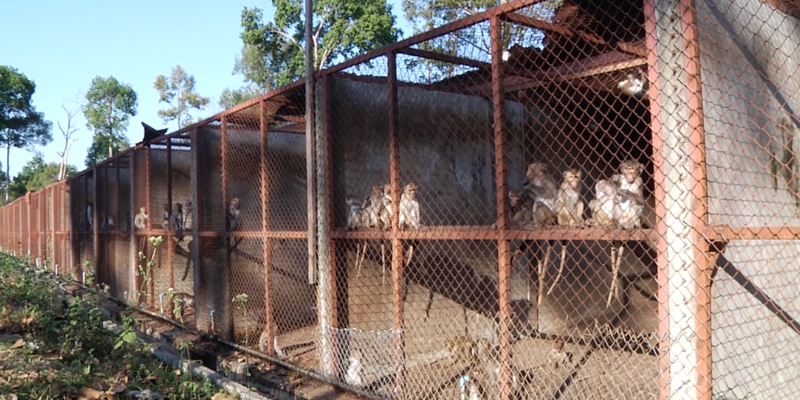
Breeding facilities are often large, sprawling structures packed with filthy, barren cages and miserable, terrified monkeys. In labs, these animals are also often condemned to live in small cages lacking enrichment. Many exhibit signs of psychological distress, such as self-mutilation or excessive grooming.
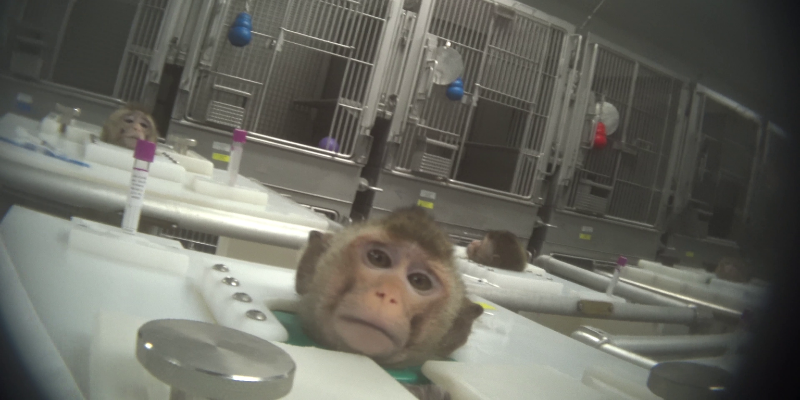
In the lab, long-tailed macaques are often used in toxicity testing, where they will be restrained and dosed by injection, infusion, or with a tube forced into their stomach. Dosing can last for months or years and cause immense suffering. Others may endure invasive procedures such as brain surgery or infection with debilitating diseases. Many are killed at the end of, or during, these cruel tests.
Shockingly, the federal government doesn’t regulate or oversee the use of animals in these cruel tests. Instead, Canada relies on the Canadian Council on Animal Care (CCAC)—a private organization dominated by animal experimenters with no legal authority—to develop guidelines for the use of animals in research. Participation isn’t legally required for labs, even those who rely on government funding, and those who do participate are generally only inspected once every three to five years in pre-announced visits.
Documented Transport Violations
Records obtained by the Animal Alliance of Canada reveal repeated violations of animal transport regulations while importing long-tailed macaques from Cambodia to Canada.
Shipments have included sick and injured monkeys, and flights lacking permits. In some cases, monkeys were left in crates for over 45 hours before landing in Montreal. In another instance, two loads of long-tailed macaques from Cambodia were deemed unfit for transport by CFIA inspectors. Their specific conditions were not recorded, but examples of what could lead to this determination include fractures, severe open wounds, or animals in shock or dying.
Current Canadian regulations allow primates to be transported for up to 36 hours without food, water, or rest—though it appears many of these flights may be exceeding this limit.
Public Health Risks
Importing primates significantly increases the likelihood of zoonotic disease transmission to humans. Worryingly, there are multiple documented instances in which veterinary inspections weren’t conducted within 10 days before shipment.
Investigations have also revealed that monkeys imported into North America from Cambodia have carried dangerous pathogens, including tuberculosis, melioidosis, and other dangerous pathogens. This puts workers at risk and highlights the current inadequacy of screening and quarantine systems.
This trade poses a serious, preventable pandemic threat.
Scientific Concerns
The scientific value of using monkeys in experiments is increasingly being called into question as studies show that the vast majority of drugs that appear safe in animals fail in human trials. Modern, human-relevant methods like organ-on-a-chip technology and advanced computer modelling are rapidly advancing and provide faster, more accurate data.
Despite close genetic similarity, the differences in physiology, metabolism, and immune systems in non-human primates make them poor predictors of human reactions.
E-Petition 7020 Calls for Federal Action—Add Your Voice
This e-petition urges the federal government to take immediate, concrete action to address these concerns, calling on the Minister of the Environment, Climate Change and Nature to:
- Launch a formal investigation into the legality, traceability, and authenticity of permits used to import macaques from Cambodia
- Add long-tailed macaques to Schedule II of the Wild Animal and Plant Trade Regulations (WAPTR), which would require Canada to issue its own import permits and verify that each shipment is legal and ethically sourced
Canada has a responsibility to avoid enabling illegal trade or contributing to the decline of an endangered species. Continuing to import long-tailed macaques—despite evidence of trafficking, ongoing welfare violations, and public health concerns—is dangerous and irresponsible.
Join us in urging the federal government to stop Canada’s role in this cruel and unsustainable trade!

