

Update: The public comment period for Canada’s updated Beef Cattle Code of Practice closed June 12, 2026.
For the first time since 2013, the Code of Practice for the Care and Handling of Beef Cattle is being updated. The Code serves as the primary guideline for farmers raising nearly 12 million steers and heifers annually for food in Canada.
The Code is not law. In fact, there are effectively no laws to prevent the suffering of the hundreds of millions of animals on farms in Canada.
Instead of animal protection laws, the government permits the animal agriculture industry to set its own voluntary standards through the National Farm Animal Care Council (NFACC)—a private industry-led body with no legislative authority. These guidelines are laid out in NFACC’s Codes of Practice for farmed animals.
Members of the public are invited to take part in the consultation process, but calls to improve conditions for animals are usually ignored. NFACC is notorious for prioritizing industry interests over the well-being of animals.
It’s no surprise that Canada has some of the worst animal protection laws in the Western world, and was given a “D” grade in the Animal Protection Index by World Animal Protection.
NFACC Codes of Practice Fail to Protect Animals
NFACC often presents itself as a neutral authority, but its structure and decision-making processes raise important concerns:
- The majority of members (87 percent) financially benefit from large-scale intensive factory farming.
- Only a very small number of seats (two) are held by independent animal welfare organizations.
- Its standards are voluntary, not law.
- It has no enforcement powers.
- It receives public funding while operating with limited public accountability.
NFACC Codes of Practice permit horrific acts, such as slicing off chickens’ sensitive beaks without anesthetic, confining pigs in tiny gestation crates that prevent them from turning around, killing piglets by blunt force trauma, and live grinding of chicks.
Animal Justice’s new resource, NFACTs, breaks down how allowing the industry to write its own rules prevents real protection for animals on farms.
Cruelty in Canada’s Beef Industry
While most animals raised for beef begin their lives outdoors, they are still subjected to pain and suffering throughout their lives:
- Painful Mutilations: Farmers regularly subject animals to painful procedures like hot iron branding, dehorning, and castration.
- Abrupt Weaning: Workers abruptly separate young calves from their mothers before shipping them to sales auction yards and feedlots, causing fear and stress.
- Unnatural Diets: Feedlots force steers and heifers to eat an intensive diet high in grains to fatten them rapidly for slaughter. This unnatural diet can cause painful intestinal bloat, liver abscesses, and lameness.
- Weather Exposure: Animals face exposure to increasingly extreme weather elements, particularly at feedlots where there is no required overhead shelter.
New drone footage released by Animal Justice in spring 2026 exposes the immense cruelty at Alberta’s massive beef feedlots. The footage spans seven beef feedlots owned by MCF Feeders Cattle, Rimrock Cattle Company, John Schooten & Sons, Allied Cattle Company, and G. Thompson Livestock Co Inc. The footage also shows animals at Cargill slaughterhouse in High River, and JBS Slaughterhouse in Brooks.
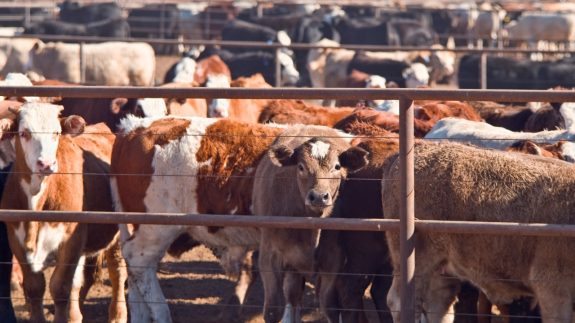
The video shows steers and heifers confined in barren, crowded feedlots unable to graze or roam freely. They are exposed to all weather extremes with no shelter from the elements. Injuries, illness, and death are common. Hundreds of thousands of animals pass through these gates every single year, and several of these operations appear to be actively expanding.
The footage also shows the beef industry’s significant environmental impact. Every feedlot and slaughterhouse documented contained massive waste lagoons, often filled with a mix of manure, urine, wastewater, and runoff.
These toxic waste lagoons contain massive amounts of bacteria, ammonia, and toxic gases. They can pollute waterways and pose serious risks to animals, wildlife, and surrounding communities.
There is nothing kind or natural about beef production. It is an industry rife with animal suffering and environmental destruction. The industry works in secrecy, but the more we can expose harmful practices, the better we are armed to push for much-needed change.