

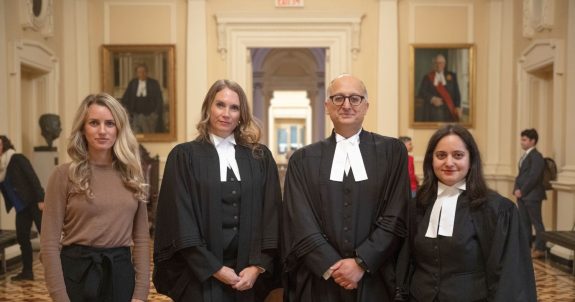

Today Animal Justice argued at the Ontario Court of Appeal in the case of a vegan firefighter who was denied appropriate food while on the job in a remote area. The Court will decide whether veteran firefighter and long-time ethical vegan Adam Knauff can move forward with an appeal—a ruling that could help shape the future of human rights law in Canada.
Alongside a coalition of respected public interest organizations at the Ontario Court of Appeal, Animal Justice argued about the proper test the Court should consider when deciding whether to hear an appeal with public interest implications. The coalition includes the Advocacy Centre for Tenants Ontario, Canadian Civil Liberties Association, Centre for Free Expression, Democracy Watch, and Income Security Advocacy Centre.
Fighting for Recognition of Ethical Veganism as a Protected Belief
Adam Knauff, a veteran firefighter, has been an ethical vegan for more than 25 years to avoid harming animals. In 2017, while battling wildfires in British Columbia, his employer repeatedly failed to provide him with appropriate vegan food—leaving him hungry for days. When he raised concerns, he was disciplined and suspended without pay.
Challenging Discrimination at the Human Rights Tribunal
Arguing that ethical veganism is a protected “creed” under the Human Rights Code, Mr. Knauff first filed a complaint with the Human Rights Tribunal of Ontario (HRTO). The HRTO dismissed his case, claiming veganism didn’t meet its definition of a creed because it “does not address the existence or non-existence of a Creator.”
This narrow interpretation was troubling not only for ethical vegans, but for other important belief systems that are not directly connected to religion.
Expanded Legal Protections for Non-Religious Beliefs
In 2015, the Ontario Human Rights Commission updated its policy on preventing creed-based discrimination. This change explicitly acknowledged the importance of non-religious belief systems, which Animal Justice was a driving force behind.
According to the policy, “Creed may also include non-religious belief systems that, like religion, substantially influence a person’s identity, worldview and way of life.” Ethical veganism is a clear example of such a belief system.
A Case Years in the Making
Mr. Knauff sought judicial review of the HRTO’s decision from the Divisional Court of Ontario. Though the Court dismissed the case on a procedural technicality, it did not reject ethical veganism as a protected belief.
Today, Mr. Knauff asked the Ontario Court of Appeal to hear his case. This critical step could overturn earlier rulings and affirm that ethical veganism deserves protection under Canadian law.
What’s at Stake Today?
Today’s hearing could set a new standard for how public-interest cases are decided in Canada, ensuring that important human rights questions aren’t dismissed before being properly heard.
The Court will determine whether Mr. Knauff should be granted leave to appeal, which would allow his case to proceed. The question is what the proper test is for allowing appeals from decisions of the Divisional Court.
- The traditional leave test focuses narrowly on the merits of the appeal and whether the case is of broad importance to the administration of justice.
- Animal Justice and the coalition are urging the court to adopt a more progressive, public-interest test. This should focus on whether the appeal raises questions of “public importance”.
The Fight for a More Inclusive Legal System
In this hearing, Animal Justice lawyers argued behalf of the coalition for a fairer, more inclusive approach to appeals that serve the public good. Cases like Adam Knauff’s—which raise questions about human rights and belief systems—must have a path to be heard.
This case could set an important precedent in Canadian human rights law. It could open the door to broader protections for ethical veganism and other deeply held convictions that deserve legal respect and accommodation.
Animal Justice will continue to provide updates on this case.