


Animal Justice has uncovered deeply disturbing information about how the Toronto Police Service treats Toronto mounted police horses. Documents obtained through a Freedom of Information request reveal that the Mounted Unit follows internal policies that authorize officers to harm and even kill their horses. Horses don’t belong in dangerous policing situations, and it’s time to retire them for good.
Toronto Mounted Police Horses Used in High-Risk Situations
The Toronto Police Service Mounted Unit houses approximately 21 horses at the Horse Palace at Exhibition Place in downtown Toronto. These horses, including Moose, Queen, Ogichadaa, Phantom, and Fred, are used in crowd management and street patrolling. Horses have a natural tendency to flee danger or busy situations because they are prey animals. Forcing them to encounter danger or large crowds is inconsistent with their instincts. Using horses in policing regularly puts them in harm’s way.
For example, a four-year-old Clydesdale named York was struck by a vehicle on Queen Street West in 2024. A video of the scene shows that the driver in a stolen pickup truck hit York while allegedly attempting to escape from police. Using horses for law enforcement is inherently dangerous for these animals.
Horses also often appear visibly uncomfortable during public events. When Taylor Swift’s Eras Tour came to the Rogers Centre, the police forced horses forced to work at the exceptionally busy venue. The bits in the horses’ mouths apply intense pressure to sensitive areas, which clearly caused discomfort, along with the loud, chaotic environment.
Internal Policies Normalize Physical Abuse
The Mounted Unit’s internal policies also shine a troubling light on how horses can be treated. Shockingly, officers are permitted to hit horses as a form of discipline. Officers can strike horses with an open hand on the shoulder, neck, or hindquarters. Permitting officers to strike defenceless animals is inhumane and inappropriate.
Research shows that punitive training methods are commonly misused. Instead, positive reinforcement creates safer outcomes for both animals and humans. Aggressive behaviours in horses are often driven by fear or stress.
Life-&-Death Decisions Made Without Veterinary Oversight
The policies also authorize officers to make critical healthcare decisions in some circumstances. Notably, officers are not required to be veterinarians.
Officers may:
- Administer medical treatments
- Inject drugs using needles
- Perform the serious, irreversible act of euthanasia in crisis situations
If an officer determines a horse is ill or injured, they must bring it to the attention of the Training Sergeant. However, the policy doesn’t require consultation with a veterinarian in emergencies. Once a course of action is determined, the reporting officer will perform the required treatment. This may even include administering drugs to the horse using a needle.
The policy leaves it to the individual officer to decide if an injury to a horse is “so catastrophic that there is no chance of recovery”—a question clearly best suited for veterinary professionals, not a law enforcement officer.
How Officers May Kill Horses in the Field
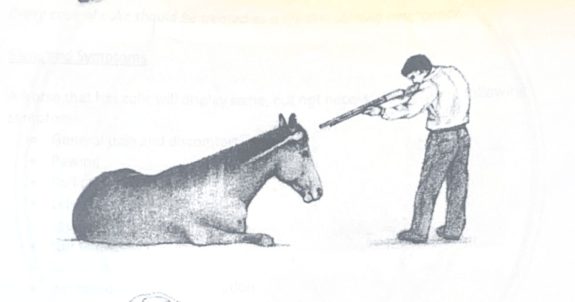
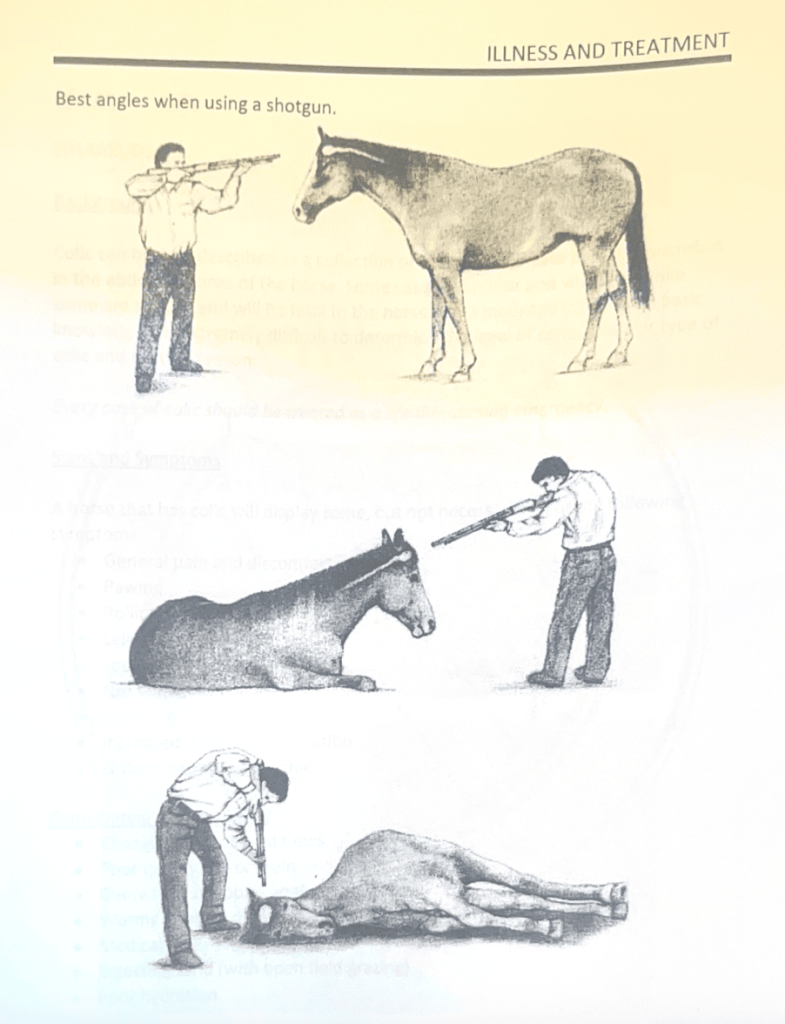
When an officer does decide to kill a horse, policy instructs them to use a “powerful enough weapon” like a shotgun. Mounted police do not carry shotguns, so another unit would have to be called to deliver the weapon—taking valuable time that could be better spent calling a veterinarian. The obtained documents even include upsetting diagrams depicting how to kill these gentle creatures at close range.
This policy treats Toronto mounted police horses as disposable equipment rather than living beings.
Toronto Mounted Police Budget Puts Horses Last
The Toronto Police are requesting a shocking $6.9 million dollars of taxpayer dollars for the Mounted Unit in the 2026 City of Toronto budget cycle. However, only a tiny fraction of the Mounted United was allocated to animal care: In 2025 $155,900 was proposed for supplies and $39,800 for veterinary services.
Given these figures, it’s difficult to understand why the City fails to ensure round-the-clock veterinary access. These horses are routinely placed in harm’s way against their will, yet their medical care is an afterthought.
It’s Time to End Mounted Policing
Horses do not and cannot consent to being forced into unpredictable situations at risk of injury, suffering, and death. The Toronto Police Service must immediately remove internal policies that allow officers to hit, harm, or kill horses. More importantly, Toronto must end mounted policing altogether and close its Mounted Unit for good.