

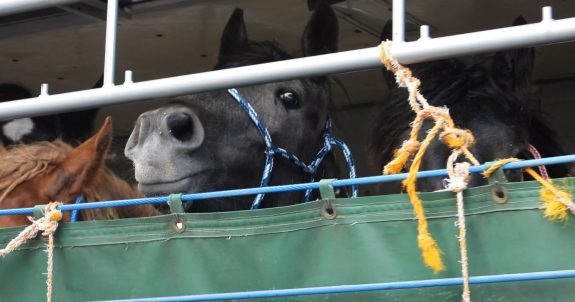

A Manitoba court has found Carolyle Farms not guilty of violating federal animal transport laws in a rare private prosecution brought forward by Animal Justice. We are disappointed by the decision, which allows the exporter to avoid accountability despite failing to protect the animals in its care.
On February 27, 2024, Animal Justice successfully laid a charge against Carolyle Farms, a live horse exporter based in Swan River, Manitoba, over an unlawful shipment that lasted well over 33 hours. This duration far exceeded the legal 28-hour travel limit for horses to go without food, water, or rest. Tragically, three horses collapsed on the plane during this journey. Animal Justice charged Carolyle Farms for failing to have a contingency plan in place should something go wrong during the export of the horses.
Private Prosecution Holds Live Horse Exporter Accountable
A Manitoba judge allowed the charge to proceed last year, after federal authorities, the Canadian Food Inspection Agency (CFIA), failed to take enforcement action. The trial was held in February 2026 in Winnipeg, marking a rare use of the private prosecution process, where charges are laid by a private individual rather than authorities.
This case was likely the first private prosecution involving farmed animals to ever reach trial in Canada.
CFIA Approved Shipment Despite Known Time Limit Violation
Each year, thousands of Canadian horses are shipped in wooden crates to Japan for slaughter—where they are eaten raw as sashimi, a luxury product for the wealthy. These journeys are extremely stressful and dangerous. Each additional hour in transit increases the risk of injury, suffering, or death for sensitive horses.
On December 12, 2022, Carolyle Farms prepared to export horses from the Winnipeg airport. A heavy snowstorm made a scheduled stop in Anchorage, Alaska, impossible. However, the horse exporter did not cancel or postpone the shipment. Instead, the company rerouted the flight through Seattle. It was clear at the time that this decision was made that it would push the travel time well beyond the legal limit.
The Trial
During the trial last month, CFIA staff confirmed they knew the shipment would unlawfully exceed 28 hours, but approved it anyway. They also admitted that the CFIA did not have a contingency plan on file that covered the entire duration of the horses’ journey.
Animal Justice’s prosecution focused on the exporter’s legal obligation to prepare for foreseeable disruptions. Weather delays are a known risk in international air transport, particularly when flying through Alaska in the dead of winter. We argued that the exporter failed to ensure a contingency plan was in place for the entirety of the journey from Swan River to the quarantine facility in Kagoshima, Japan. This legal safeguard aims to prevent animal suffering when plans change or delays happen.
Ultimately, the Court acquitted Carolyle Farms, finding it was unclear whether having a contingency plan for the flight was the responsibility of Carolyle Farms, rather than Korean Air or Sea Air—the companies hired to assist with the transport.
Animal Transport Laws Are Only Effective if They’re Enforced
Animal Justice is concerned that the judgment undermines the enforceability of animal transport laws and leaves vulnerable horses at even greater risk of suffering during transport—an incredibly stressful time. We will be reviewing the decision carefully and considering whether an appeal is appropriate.
There are few laws in place to protect the welfare of horses exported for slaughter. Animal transport laws exist to prevent suffering—but without enforcement, they are meaningless. Animal Justice will continue to use all legal tools available to ensure existing animal protection laws are upheld, and violators of those laws are held accountable.

