
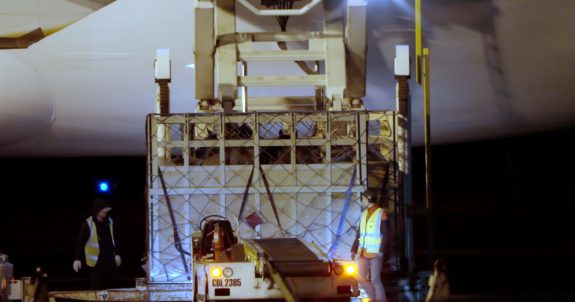

Animal Justice and the Canadian Horse Defence Coalition (CHDC) have filed a legal complaint with federal and provincial authorities over a shipment of horses destined for slaughter in Japan. The complaint calls for an investigation into the April 14, 2025 flight of horses from the Edmonton International Airport to Kitakyushu, Japan that appeared to contravene federal and provincial law.
Horses Collapsed & Suffered During Loading & Flight to Japan
A report by the Canadian Food Inspection Agency (CFIA), obtained by the CHDC, revealed that a three-year-old Belgian horse fell down inside one of the crates during loading, and showed visible signs of distress. Instead of providing care to the distressed horse, staff prodded him with sticks and poured water on him for over half an hour. Shockingly, a staff member even sought permission to use an electric prod on the terrified horse to force him to stand. Fortunately, this illegal and inhumane request was denied; however, it is unclear why the exporter had an electric prod on-hand, given that it is unlawful to electrocute horses during transport and loading.
After nearly an hour of trying to force the distressed horse to stand, the decision was finally made to send him and two other horses back to the feedlot. Tormenting this horse for so long demonstrates a complete disregard for transport laws.
Sadly, the suffering of horses did not end there. CFIA documents reveal that another horse collapsed on the flight to Japan, and was apparently left to suffer on board for nearly two hours. Four horses also went down on landing in Japan due to the pilot hard-braking on the runway.
Horses Were Unlawfully Denied Food, Water, & Rest for Over 28 Hours
In addition to the illegal distress these horses suffered, they were also forced to endure transport without food, water, and rest for more than 28 hours—a clear violation of Canadian law. Based on the exporter’s own numbers, the animals were in transport without food, water, and rest for at least 29 hours. Canada’s already cruel and outdated 28 hour transport limit for horses causes the animals to experience prolonged fear and distress, and exposes them to risks of illness and injury. Going over that limit by any amount compounds horses’ already extreme thirst, hunger, and terror.
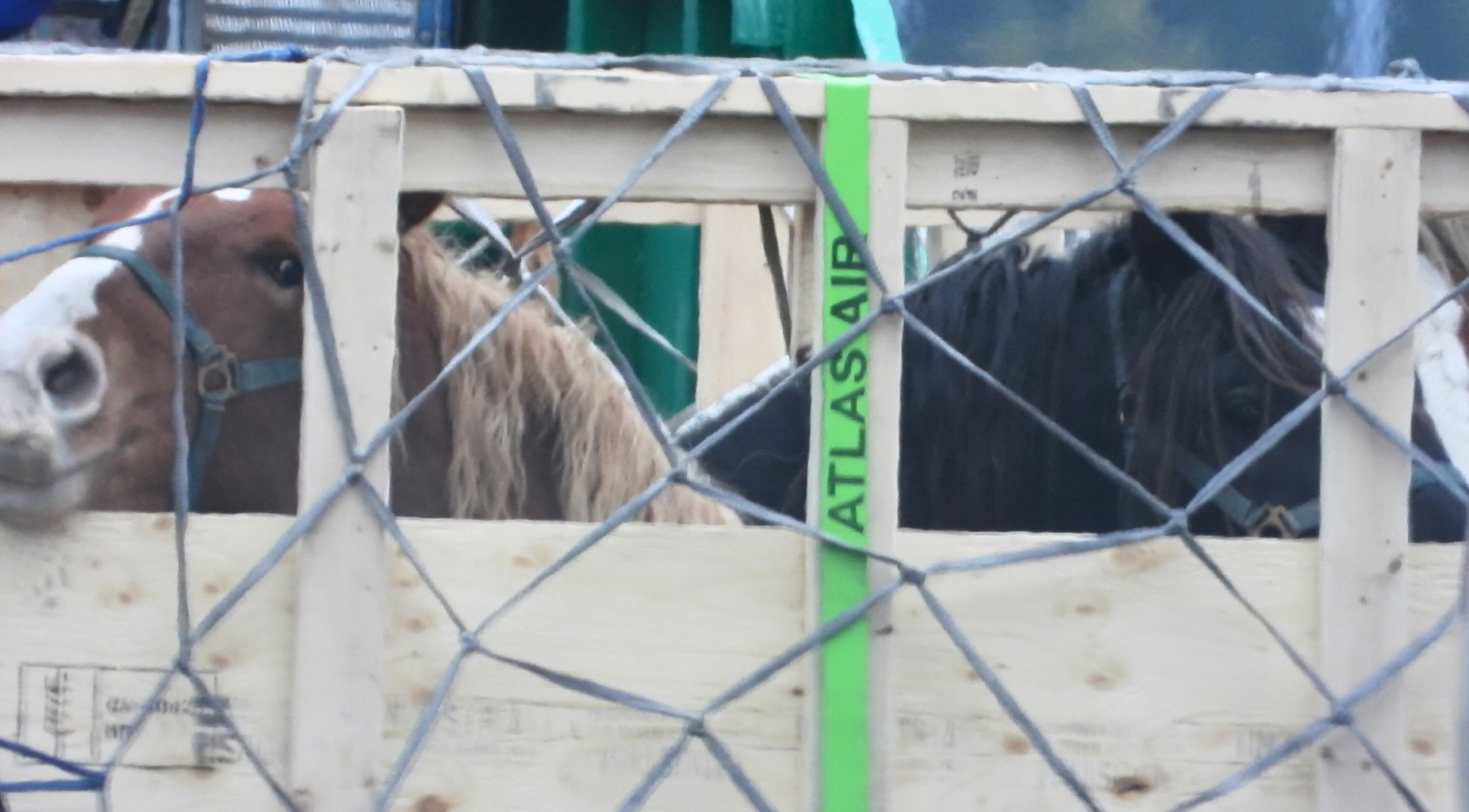
When horses are shipped to Japan for slaughter, they are trucked long distances to the airport, where they are then forced into cramped wooden crates with two to four horses per crate. Workers have been filmed numerous times using metal poles to jab horses through the transport truck openings in order to force the frightened animals to move off of the trucks. Once they are loaded into crates, horses often spend hours on the loud tarmac before finally being loaded into cargo planes for the long flight to Japan. Travel is an especially difficult and stressful process for these horses. They are not trained or conditioned for transportation, and their biology makes them ill-suited for transportation, causing them to be prone to dehydration, injury, and fatigue.
Once in Japan, horses are reloaded onto trucks, then doused directly with harsh disinfectant chemicals as they arrive at quarantine facilities. Desperate and dehydrated, many horses attempt to lick this harsh liquid off of the trucks. This practice would be illegal if done in Canada and causes already stressed and exhausted horses to endure further suffering as their eyes, skin, and airways are irritated, likely causing pain and burning. Canada’s horse exporters should not be allowed to send horses to countries where they will be subject to cruel practices that are illegal in this country.
After this horrific journey, the horses are fattened in feedlots and slaughtered for luxury sashimi.
Horse Export for Slaughter Industry Regularly Violates the Law
The distress and suffering these horses experienced during the shipment from Edmonton is not an isolated occurrence. Federal and provincial laws are routinely violated by horse exporters. In two separate reports last year, Animal Justice showed most shipments exceeded the 28-hour legal maximum limit for transport without food, water or rest, and that horses regularly suffer injuries, illness and even death in connection with the flights—in contradiction to claims made by the CFIA and the companies involved.
For example, since Animal Justice’s report was released, a shipment from Edmonton to Japan in February 2025 went over the time limit when a hydraulic lift failed in -30ºC weather conditions. CFIA records indicate the horses had frost on their backs. Another flight leaving Edmonton in late November 2024 also exceeded the 28-hour legal limit.
Despite years of repeated non-compliance with the law, it appears that no enforcement action has been taken against any exporters of horses for slaughter.
Exporting horses to Japan for slaughter is not in line with Canadian values. The Liberal government even pledged to end the exports in 2021. A bill that would have ended the industry passed in the House of Commons and was before the Senate, but got derailed by the April, 2025 election.
More than 10,000 horses have been exported for slaughter since the 2021 Liberal Party commitment to ban the practice. With every week that goes by, more horses suffer needlessly as a result of this cruel and unnecessary industry. As Edmonton-based staff lawyer at Animal Justice, Jessica Schwarz, states: “There is simply no humane way to ship live horses by air for slaughter; this practice is inherently inhumane.”
How You Can Help–Keep Horses on the Political Agenda!
The new government has a chance to make good on the Liberal promise to put an end to this brutal practice once and for all—and we need your help to make that happen! Please take action now to ban live horse exports for slaughter.